Plans by the National Democratic Congress government of President John Dramani Mahama to significantly upgrade the presidential and military air transport capacity have triggered renewed national debate, as details emerge of a proposed $1.2 billion procurement package expected to deliver new aircraft and defence assets by November 2026.
The initiative forms part of a broader retooling of the Ghana Armed Forces, to restore the ability to rely fully on state-owned assets for presidential travel and strategic operations.
The information was disclosed by the Secretary to the President, Callitus Mahama who wrote an opinion piece to douse the raging fire on President Mahama travelling in his brother’s private jet to South Korea.“Plans are already underway to strengthen Ghana’s presidential air transport capability as part of the broader retooling of the Armed Forces. By November this year, the country is expected to have additional aircraft within the presidential fleet, including one dedicated to the President’s travel.
“When that happens, Ghana will once again have the capacity to rely fully on its own state assets for the safe and efficient transportation of the Head of State. It will also remove the need for the kind of temporary arrangements that have generated the current discussion”, he said.
The plan includes the acquisition of two executive jets dedicated to presidential use, four military helicopters, and two offshore patrol vessels for the Ghana Navy. One of the helicopters was delivered last month.
NDC officials say the arrival of these assets—particularly the presidential jets—will eliminate the need for temporary travel arrangements that have recently sparked controversy, including the President’s reliance on privately owned aircraft for official trips.
Budget Disclosure Sparks Political Backlash
The proposed acquisition was formally disclosed in the 2026 Budget Statement presented by Finance Minister Cassiel Ato Forson.
However, the announcement has been met with fierce resistance from the opposition New Patriotic Party (NPP), who have described the expenditure as excessive and poorly timed given the current economic conditions.
At a press conference, former Finance Minister and Member of Parliament for Karaga, Dr. Mohammed Amin Adam, criticised the government’s priorities, arguing that the proposed spending does not reflect the pressing needs of ordinary Ghanaians.
“They have forgotten about you after getting power from you,” he said, accusing the government of using recent national security concerns as justification for what he described as an extravagant procurement plan.
He further questioned why the government would prioritise the purchase of executive jets while calling on citizens to endure economic hardship, including wage restraint and rising living costs.
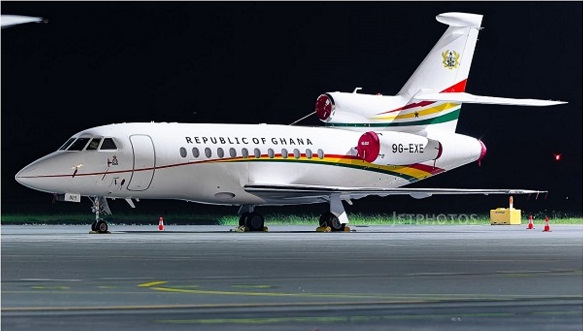
Curiously the current president jet was recently refurbished in France and it is in pristine condition according to Samuel Okudzeto Ablakwa, John Mahama’s Foreign Affairs Minister.
Historical Roots of Aircraft Procurement Controversies
The history of presidential aircraft procurement has long been fraught with controversy, dating back to the administration of former President John Agyekum Kufuor.
In 2007, Kufuor’s government initiated a plan to acquire two aircraft: a Dassault Falcon 900EX to replace the aging presidential jet, and a larger Boeing Business Jet (BBJ) designed for high-capacity VVIP travel.
While the Falcon was eventually delivered in 2010 at a cost of about $40 million, the BBJ acquisition was cancelled under the administration of President John Evans Atta Mills following public criticism over costs.
Ironically, at the time, the then-opposition National Democratic Congress (NDC), along with civil society groups, had strongly opposed the procurement, describing it as a misuse of public funds.
Allegations From Mills Era
The debate over aircraft procurement deepened during the Mills administration, when President Mahama—then Vice President and Chairman of the Armed Forces Council—was later accused of engaging in parallel negotiations for additional aircraft acquisitions.
Former Attorney General Martin Amidu alleged that Mahama pursued deals involving aircraft and hangar facilities from Brazilian manufacturer Embraer without the full knowledge of President Mills.
According to Amidu, President Mills subsequently constituted an investigative committee comprising key officials, including then Interior Minister William Aboah, George Amoah, and Brigadier General Allotey (Rtd), to examine the procurement process and ensure value for money.
However, the committee’s work was reportedly stalled and never completed before the death of President Mills in 2012, leaving lingering questions about transparency in defence procurement.
Current State Of The Presidential Jet
At the centre of the current debate is the condition of Ghana’s existing presidential aircraft, the Dassault Falcon 900EX, which has served as the main transport for heads of state for over a decade.
Defence officials say the aircraft recently underwent an extensive eight-month maintenance process in France.
During that period, engineers reportedly detected corrosion in its fuel tanks, along with fuel leakage issues in one of its wings, necessitating costly repairs.
Deputy Defence Minister Ernest Brogya Genfi explained that although the aircraft is technically airworthy, it is limited in both range and passenger capacity—able to carry only about 11 passengers excluding crew—making it unsuitable for long-haul international travel.
As a result, successive administrations have frequently resorted to chartering aircraft for official trips, a practice that has itself drawn criticism over cost and transparency.
Government Justification
Government officials further argue that the new acquisition is intended to address these long-standing limitations by providing “fit-for-purpose” aircraft capable of long-distance travel without stopovers and with sufficient capacity for presidential delegations.
They also emphasise that the additional helicopters and naval vessels will enhance national security operations, including maritime patrols and emergency response capabilities.
According to the government, investing in state-owned aviation assets will ultimately reduce the recurring costs associated with chartering aircraft while improving operational efficiency and security.
Minority Raises Cost Concerns
Despite these assurances, the Minority in Parliament insists that the $1.2 billion price tag is unjustifiable, particularly in light of the economic challenges, including high inflation, mounting public debt, and pressure on public finances.
Opposition lawmakers have demanded full disclosure of the procurement process, including tendering procedures, financing arrangements, and cost breakdowns for each asset.
They argue that the proposed expenditure far exceeds historical benchmarks. For instance, the $40 million cost of the Falcon jet under Kufuor stands in stark contrast to the current multi-billion-dollar proposal, even when accounting for inflation and technological advancements.
Some critics have also pointed to international comparisons, noting that high-end aircraft acquired by other governments have cost significantly less than the projected budget for the planned fleet.
Pattern Of Controversy
The latest development adds to a long pattern of controversies surrounding presidential aircraft procurement in Ghana.
From the cancellation of the BBJ deal to allegations of opaque negotiations and the Airbus bribery scandal linked to contracts between 2009 and 2015, successive governments have faced scrutiny over how such deals are structured and executed.
The NPP has warned that the current proposal risks repeating past mistakes, raising concerns about potential hidden interests or lack of transparency in the procurement process.
Comments