
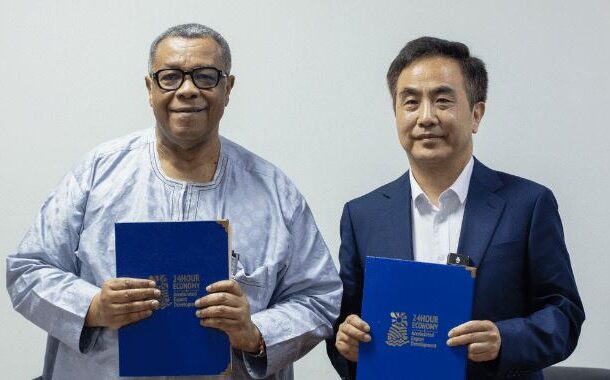
The 24H+ Economy Secretariat, operating under the Office of the President, has signed a Memorandum of Understanding (MoU) with the Hunan Architectural Design Institute Group (HADI Group) to support the industrial planning and infrastructure development of the Volta Economic Corridor (VEC).
The agreement, signed on Wednesday, April 14 in Accra, is aimed at advancing Ghana’s long-term economic transformation agenda by developing investment-ready infrastructure along the proposed corridor.
Chairman He Liu, who led the HADI delegation, expressed the group’s readiness to partner Ghana, noting that the collaboration is grounded in mutual trust and shared development goals.
“We are ready to partner for the development of Ghana. Seeing the vision reflected here gives us confidence that this collaboration is built on a strong and practical foundation,” he said.
Presidential Adviser Goosie Tanoh recalled earlier discussions held in January 2026 in Changsha, China, which laid the groundwork for the partnership. He said the current agreement reflects a shift from dialogue to implementation.
“When we sat together in Changsha, we agreed that this relationship must be practical. Three months later, here we are,” he said.
Mr Tanoh drew comparisons between Hunan’s transformation from an agrarian economy to a global industrial hub and Ghana’s own development ambitions, stressing that effective planning is central to economic transformation.
He noted that Ghana is adopting a similar planning-led approach, with HADI expected to contribute technical expertise in infrastructure design and development.
Volta Economic Corridor Project
The Volta Economic Corridor forms a central pillar of Ghana’s 24-Hour Economy Programme, aimed at restructuring production, processing, and trade.
The corridor stretches from Tema through Akosombo, Afram Plains, Yeji, Buipe, and Yapei to Tamale. It is designed as a green, net-zero industrial zone integrating agroecological parks, industrial parks, and multimodal transport systems.
Plans include the development of over two million hectares of farmland into agroecological zones linked to industrial processing hubs and transport infrastructure. The project will be financed through structured private sector investment, with renewable energy installations expected to reduce power costs to below seven cents per kilowatt hour.
The African Development Bank has also committed support for feasibility studies on the transport component. The corridor is projected to create more than 500,000 direct jobs.
Scope of the Agreement
Under the MoU, HADI Group will collaborate with the Secretariat on master planning and spatial design for key development zones along the corridor.
Key areas include the design of agroecological and industrial parks, covering roads, water systems, pipelines, and sewage infrastructure. The partnership will also explore EPC+F and EPC+I financing models to attract private capital.
In addition, the agreement provides for technical training and knowledge exchange between Ghanaian planners and Chinese engineering experts.
Both parties have agreed to begin with pilot projects involving two industrial parks and three agroecological parks, where initial design work will commence immediately before scaling up across the wider corridor.
Comments