
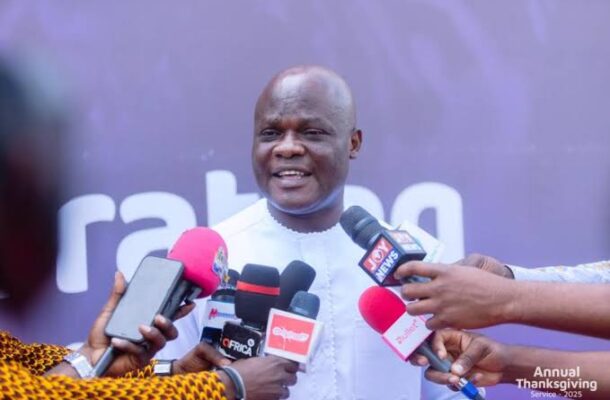
The Minister for Local Government, Chieftaincy and Religious Affairs, Ahmed Ibrahim, has stated that the government’s proposed 24-hour market programme is aimed at strengthening local economic development and improving livelihoods across the country.
According to the Minister, the initiative is designed to increase income opportunities for traders, create jobs—especially for young people and women—and enhance urban safety and sanitation.
Mr Ibrahim, who is also the Member of Parliament for the Banda Constituency, made these remarks during the annual end-of-year and New Year procession organised by the Church of Pentecost–Berekum Area at the Goka Pentecost Prayer Camp in the Jaman North District of the Bono Region. The event drew more than 1,000 congregants from various communities.
He explained that the 24-hour market programme would involve extending trading hours, upgrading market infrastructure, installing closed-circuit television (CCTV) systems, improving waste management, and promoting the use of digital payment platforms. The initiative, he noted, would be implemented through collaboration between government, traditional authorities and the private sector.
Mr Ibrahim called on key stakeholders, including Metropolitan, Municipal and District Assemblies (MMDAs), traditional leaders, religious bodies, traders and security agencies, to fully support the programme to ensure the creation of a resilient and inclusive local economy.
He assured the public that the government remains committed to providing the necessary policy, institutional and financial backing for the merger of the ministries, the sanitation agenda and other local development initiatives.
The Minister added that his Ministry would continue to build the capacity of registrars, traditional council members and faith-based organisations to effectively adapt to the new administrative framework. He noted that training programmes and closer coordination with local assemblies would remain central to the Ministry’s priorities.
Mr Ibrahim emphasised that the success of the government’s initiatives depends on collective responsibility, urging all stakeholders to serve as agents of change by promoting efficiency, transparency, discipline and harmony among the Ministry, traditional authorities, religious leaders and local government institutions.
He also highlighted the need to strengthen collaboration between Ghana’s cultural and spiritual institutions and modern governance systems, stressing that progress requires building bridges rather than barriers.
Mr Ibrahim concluded that the merger of the Ministry of Local Government with the Ministry of Chieftaincy and Religious Affairs represents a new phase in Ghana’s governance structure, grounded in unity, integration and shared responsibility.
“Together, we can enhance the role of chieftaincy and religion in national development, promote effective local governance, and build cleaner, safer and more resilient communities,” he said.
Comments