
A new Ride-Hailing Safety Index Report commissioned by Bolt and conducted by global research firm Ipsos has revealed that 81% of Ghanaians consider ride-hailing services safer than other modes of transport.
The nationwide survey, conducted in Accra, Kumasi, Tamale, and Takoradi, highlights the growing confidence in app-based mobility solutions and their contribution to safety, reliability, and convenience in urban transport.
The findings were shared at a press briefing hosted by Bolt, which brought together government officials, transport experts, and road safety stakeholders to discuss how technology-driven platforms can further enhance public confidence and safety within Ghana’s transport ecosystem.
According to the report, convenience (80%) and safety (45%) are the top reasons Ghanaians choose ride-hailing services. An overwhelming 92% of respondents said they use ride-hailing apps when they want a safer or more reliable trip — particularly at night (70%), when walking feels unsafe (50%), or when they are tired or unwell (46%).
The study also found that women account for 70% of ride-hailing users in Ghana, with most being between 25 and 34 years old. This, according to the report, underscores the importance of digital mobility in offering safe and flexible travel options for young women and urban professionals.
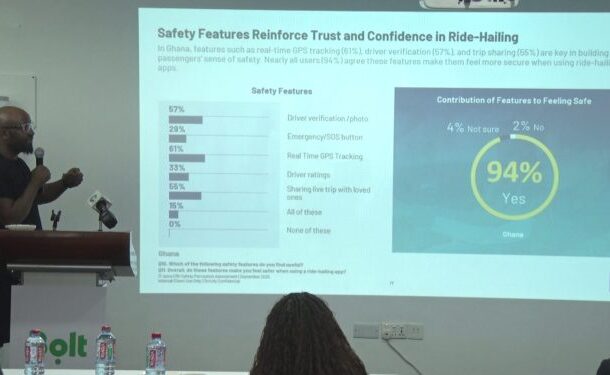
Key safety features such as real-time GPS tracking (61%), driver verification (57%), and trip sharing (55%) were ranked as the most trusted tools for enhancing passenger confidence. Overall, 94% of respondents said these in-app features make them feel more secure when using ride-hailing services.
Additionally, 52% of those surveyed believe ride-hailing apps help reduce drunk driving by offering a safe alternative after social outings — a positive contribution to public safety.
“This report gives us valuable insight into how Ghanaians perceive safety in ride-hailing,” said Sandra Suzanne Buyole, Bolt’s Regional PR Manager for Ghana. “It shows that safety is not only a key reason people choose digital mobility, but also a continuous area for investment in technology, driver education, and collaboration with regulators.”
Witness Soyinka, Head of Strategy Africa at Ipsos, added that the findings demonstrate how ride-hailing is becoming synonymous with “reliability, traceability, and accountability” — essential ingredients for building lasting trust in modern mobility services.
The Ride-Hailing Safety Index Report will serve as a data-driven tool to guide future innovation and policy collaboration across Ghana’s transport sector, supporting Bolt’s mission to make urban mobility safer, smarter, and more inclusive for all.
Comments