







Ghana foreign languages to remain optional under proposed school curriculum
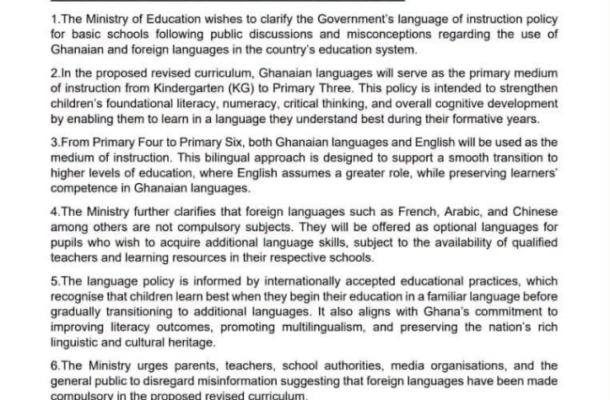
The Ministry of Education has rejected claims that pupils in Ghana will be required to study foreign languages, including French, Arabic and Chinese, under proposed changes to the language of instruction in basic schools.
The clarification comes after intense public debate and speculation about the Government’s revised curriculum. Reports circulating on social media and other platforms had suggested that children would have to begin learning one or more foreign languages from the early years of school.
However, the Ministry said foreign languages would remain optional. They would be available only to pupils who wanted to develop additional language skills and at schools with the necessary teachers and learning materials.
Under the proposed revised curriculum, Ghanaian languages will be used as the main medium of instruction from Kindergarten (KG) through to Primary Three.
The Ministry said the policy was intended to help children build stronger foundations in literacy and numeracy, while also supporting critical thinking and wider cognitive development during their formative years.
It said international research consistently showed that children generally achieved better educational outcomes when taught in a language they already understood. Familiar-language instruction can help pupils grasp ideas more quickly, take part more confidently in lessons and develop stronger communication skills.
Education officials believe the approach will create a firmer foundation for learning while also strengthening Ghana’s linguistic and cultural identity.
Gradual move to English
The proposed policy would introduce a gradual shift from Primary Four. Ghanaian languages and English would both be used as mediums of instruction from Primary Four through to Primary Six.
The Ministry said the bilingual model would help prepare pupils for higher levels of education, where English becomes increasingly dominant as the language of instruction.
At the same time, continuing to use Ghanaian languages alongside English is intended to maintain pupils’ ability in their mother tongues, support multilingualism and help prevent the gradual loss of indigenous languages.
The Ministry said the policy was based on internationally recognised educational principles, which recommend that children begin their education in their first language before gradually learning additional languages.
Research from educational institutions and international organisations has found that early education in a familiar language can improve literacy, comprehension, participation in the classroom and long-term academic performance, according to the Ministry.
It added that the proposal was also consistent with Ghana’s wider educational goals, including improving literacy levels, promoting multilingual education and protecting the country’s diverse linguistic and cultural heritage.
By developing competence in both Ghanaian languages and English, the Government wants learners to be academically prepared while remaining connected to their cultural roots.
The Ministry urged parents, teachers, school administrators, media organisations and the wider public to ignore misinformation about the proposed curriculum.
It specifically said claims that foreign-language study had been made compulsory were false and did not represent Government policy.
Officials encouraged stakeholders to seek information through the Ministry’s official channels before reaching conclusions about the proposed reforms.
The Ministry reaffirmed its commitment to strengthening Ghana’s education system and said it remained focused on implementing evidence-based policies aimed at improving teaching and learning across the country.



Popular News
No trending posts found.