
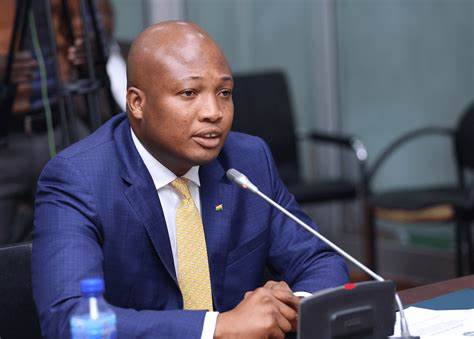
Foreign Affairs Minister and North Tongu MP, Samuel Okudzeto Ablakwa, was caught fumbling with answers when he was confronted with the controversial Gitmo 2 case, virtually accusing the Attorney General of misleading President John Dramani Mahama into accepting the U.S. deportees without parliamentary approval.
His remarks follow fresh criticism of the government’s recent decision to accept deportees from the United States under a Memorandum of Understanding (MoU) — an arrangement critics say should have gone before Parliament for ratification.
Background: The Gitmo 2 Controversy
In January 2016, Ghana agreed to host two Yemeni ex-detainees from the U.S. detention facility at Guantanamo Bay — Mahmud Umar Muhammad Bin Atef and Khalid Muhammad Salih Al-Dhuby.
The Mahama administration described the move as a humanitarian act, stressing that the men posed no security threat.
However, the decision sparked national uproar.
Civil society groups, opposition politicians, and private citizens filed a lawsuit, arguing that the transfer was unconstitutional because Article 75 of the 1992 Constitution requires all international agreements binding Ghana to be ratified by Parliament.
At the time, Dr. Dominic Ayine — then Deputy Attorney General and now the current Attorney General — represented the state at the Supreme Court.
He argued that the transfer was merely an executive arrangement and did not require parliamentary approval.
But in 2017, the Supreme Court, in a landmark ruling, rejected this position. Delivering the judgment, then Chief Justice Sophia Abena Akuffo declared that:
“Upon a true and proper interpretation of Article 75 of the 1992 Constitution of Ghana, the President of the Republic of Ghana, in agreeing to the transfer of Mahmud Umar Muhammad Bin Atef and Khalid Muhammad Salih Al-Dhuby to the Republic of Ghana, required ratification by an Act of Parliament, or a resolution of Parliament supported by the votes of more than one-half of all Members of Parliament. By virtue of the failure to obtain such ratification, the agreement is unconstitutional.”
The ruling in the case Margaret Banful and Henry Nana Boakye v. The Attorney-General and Ministry of Interior set a precedent for how international agreements must be handled in Ghana.
Ablakwa’s Concerns
Speaking on Channel 1 TV’s The Point of View, the host of the programme, Bernard Avle pointed out to Okudzeto Ablakwa the Supreme Court’s decision showing that Mahama’s government had been misled by the Attorney General’s advice.
“These guys never learn,” he remarked, stressing that the Constitution does not distinguish between treaties, MoUs, or diplomatic notes when they impose binding obligations between states.
“The judgment was very clear on the Guantanamo case. Whatever name you give it — whether treaty, agreement, or MoU — once two countries agree on something that binds them, it requires parliamentary ratification. Only one judge dissented; it was a majority decision,” the host Bernard Avle noted.
He expressed surprise that government officials continue to argue that MoUs do not need parliamentary scrutiny, especially given the legal clarity provided by the Gitmo 2 ruling.
New Deportee Arrangements Raise Alarm
The debate resurfaced after the government accepted 14 West African deportees from the U.S. earlier this month.
Critics, including the Minority in Parliament, accused officials of bypassing Parliament once again
Okudzeto Ablakwa, however, clarified that Ghana is expecting 40 more deportees in the coming days, insisting that humanitarian grounds informed the decision.
He explained that Ghana could not turn away Africans who had been mistreated abroad and left without refuge.
“We’re not doing the U.S. a favour. We’re doing our fellow Africans a favour. We saw the arrests, the violations of their rights, and their detention against their will. No one wants to take them, so Ghana is stepping in as a refuge,” Okudzeto Ablakwa explained.
Nonetheless, he admitted that the arrangement was discussed in Cabinet and approved based on the Attorney General’s advice — advice which has become increasingly questionable in light of past legal precedent.
Constitutional Lessons Still Ignored?
The host acknowledged that the ruling on the Gitmo 2 created a binding precedent under the constitutional law.
He stressed that the Supreme Court had ruled that the terminology of an agreement is immaterial — whether MoU, treaty, or diplomatic note, Article 75 requires parliamentary ratification.
He questioned how government could enforce what the minister described as a “loose understanding” with the United States if it did not have the force of law through Parliament.
“It’s contradictory to call it a loose agreement and still enforce it. That was the problem with the Gitmo 2 arrangement, and that’s why the Supreme Court struck it down,” he argued.
Comments