
Accra floods halt businesses
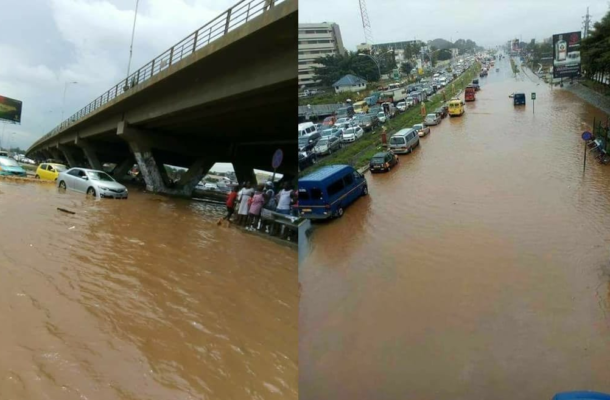
Business activities across the capital came to an abrupt standstill on Monday after hours of heavy overnight rainfall triggered widespread flooding, leaving traders, transporters and motorists stranded while disrupting the movement of goods into Accra’s major commercial centres.
The floods inundated several communities and major roads across the Greater Accra Region, with floodwaters entering homes, offices and business premises, forcing many commuters to abandon their journeys and bringing economic activity to a near halt.
Among those hardest hit were traders transporting food commodities from farming communities to Accra’s markets for the start of the trading week.
Several trucks loaded with tomatoes and other perishable goods were left stranded along key highways leading into the capital after floodwaters made sections of the roads impassable.
The President of the Tomato Transporters Association of Ghana, Eric Tuffour, described the situation as a major setback for traders whose livelihoods depend on the timely delivery of fresh produce.
Speaking in an interview, Tuffour disclosed that some of the association’s members had been forced to park their trucks along the roadside after becoming trapped by the floods.
“One of the drivers called me and said they are stuck at Nsawam because the Pokuase road is now inundated with no vehicle able to move to access the market centre. All our big markets are in Accra Central and since it’s flooded, what they can do is just park,” he explained.
According to transporters, floodwaters completely covered sections of the highway, effectively cutting off access to the capital and leaving long queues of vehicles stretching in both directions.
The disruption comes at a particularly critical time for traders, as Mondays are traditionally one of the busiest trading days when trucks transport agricultural produce from rural communities to major urban markets, including Accra and Kumasi.
With many of the trucks unable to reach their destinations, concerns are mounting over potential financial losses resulting from the spoilage of perishable food items.
Tuffour warned that tomatoes, in particular, require early morning offloading to preserve their freshness and market value.
“Tomatoes are highly perishable, and we must offload them early in the morning. But the trucks are stuck on the road. This would really affect us. This is a very bad situation for us as a country,” he lamented.
The flooding has also disrupted the operations of traders who rely on regular supplies from farming communities to meet customer demand throughout the week.
Market operators fear that prolonged delays could lead to shortages of fresh produce and possible increases in food prices if the situation persists.
The latest flooding incident once again highlights the recurring challenge of poor drainage and inadequate flood management in parts of Accra, where heavy rains frequently result in extensive damage to property, disruption of transportation and economic losses.
Weather forecasters had earlier predicted continued rainfall across parts of southern Ghana, with the rains expected to persist until midday.
In response to the deteriorating conditions, the Minister for the Interior, Muntaka Mohammed-Mubarak, appealed to residents of Accra to work from home where possible in order to reduce traffic congestion and minimise the risk to public safety.
Emergency services and relevant state agencies continue to monitor the situation as authorities urge motorists and residents to avoid flooded roads and waterways until water levels subside.






Popular News
No trending posts found.