
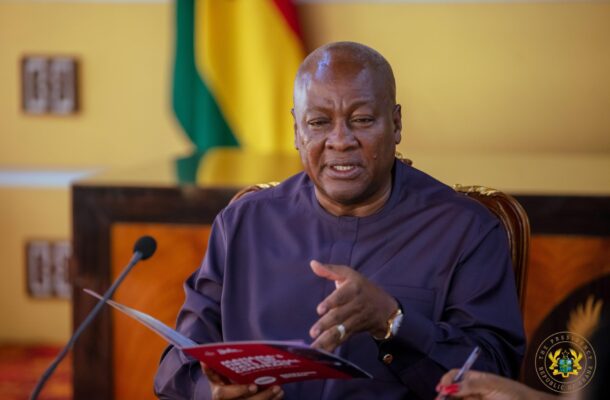
The visit of President John Dramani Mahama to Arusha, Tanzania, for the opening of the 2026 judicial year of the African Court on Human and Peoples’ Rights has reignited a wider continental debate about Africa’s unfinished integration project and the long-delayed establishment of a supranational African Court of Justice.
The event, which also marks the Court’s 20th anniversary, is historic in itself — the first time a sitting President of the Republic of Ghana has been invited to address the Court — but African policy advocates insist the symbolism must translate into structural action.
The Africa Prosperity Network (APN) has framed Mahama’s presence in Arusha not just as ceremonial participation, but as a strategic moment to push for the completion of Africa’s judicial architecture.
According to APN, the anniversary theme, “20 Years of Service in Protecting Human and Peoples’ Rights in Africa,” should serve as a bridge between human rights protection and the enforcement of economic and integration rights across the continent.
This call gains urgency against the backdrop of looming continental milestones. Mahama is expected to assume the Chairmanship of the African Union in February 2027, while the year 2028 marks the deadline set under the Abuja Treaty for the establishment of the African Economic Community — the vision of a single African market. APN argues that without a binding legal enforcement system, these timelines risk becoming symbolic rather than transformative.
Mahama’s trip also includes bilateral engagements with Tanzanian President Samia Suluhu Hassan, reinforcing the diplomatic push for visa-free travel among all AU Member States. For integration advocates, this diplomatic agenda fits naturally into a broader continental strategy: free movement of people, goods and services cannot function sustainably without a common legal authority to interpret and enforce shared rules.
Behind the anniversary celebrations, however, lies a largely forgotten institutional failure. In 2003, African leaders adopted the Protocol on the Court of Justice of the African Union in Maputo, envisioning a continental court with authority to enforce AU law. More than two decades later, that vision remains unrealised. Subsequent legal instruments sought to advance the project — including the 2008 Protocol establishing the African Union Court of Justice and Human Rights, and the 2014 Malabo Protocol, which proposed expanded jurisdiction including criminal matters.
Yet ratification has stalled. Only about eight AU Member States have ratified the 2008 Protocol, far below the 15 required for it to enter into force.
APN argues that this implementation gap has direct economic consequences. A single market, it insists, is not only an economic arrangement but a legal order. Trade liberalisation, free movement, mutual recognition of qualifications and the right of establishment all create binding rights and obligations.
Without a supranational court to interpret AU law uniformly, each Member State applies integration commitments through its own legal and political frameworks, producing regulatory fragmentation, legal uncertainty and uneven implementation.
In practical terms, this fragmentation undermines investor confidence and entrepreneurial growth. African and global investors lack assurance that treaty obligations will be protected beyond domestic political changes. Small and medium-sized enterprises, professionals and traders face uncertainty about whether their cross-border rights will be respected consistently across jurisdictions. APN maintains that enforcement, not declarations, is the missing pillar of Africa’s integration agenda.
Contrary to fears of sovereignty erosion, the Network argues that a supranational African Court of Justice would strengthen collective sovereignty by ensuring that commitments voluntarily entered into by Member States are honoured uniformly. In the same way national supreme courts protect constitutional order within states, a continental court would safeguard the constitutional order of the African Union itself.
This legal gap, APN notes, also connects directly to Africa’s most pressing socio-economic challenge: mass poverty. The organisation argues that poverty cannot be tackled without economic scale, and scale requires integrated markets, infrastructure, labour mobility and capital flows — all of which depend on enforceable legal frameworks.
These arguments form the foundation of APN’s Make Africa Borderless Now! Movement, launched on 6 February 2026. Item 10 of the campaign explicitly calls for the operationalisation of a supranational African Court of Justice to enforce AU law and single market rules uniformly across Member States.
The movement is mobilising a petition campaign targeting 10 million signatures, to be presented to African leaders at the AU Summit in Addis Ababa in 2027.
Comments