
Cocoa farmers in the Ashanti Region have intensified calls for the restoration of the previous cocoa producer price, arguing that even during the economic shocks of the COVID-19 pandemic under former President Nana Addo Dankwa Akufo-Addo, the state managed to sustain the economy, pay public sector workers, maintain utilities, and crucially, keep cocoa prices stable.
The farmers insist that if the previous administration could avoid reducing cocoa prices under such severe global pressures, the current government led by John Dramani Mahama should, at the very least, maintain the existing price rather than impose what they describe as a painful “haircut” on their livelihoods.
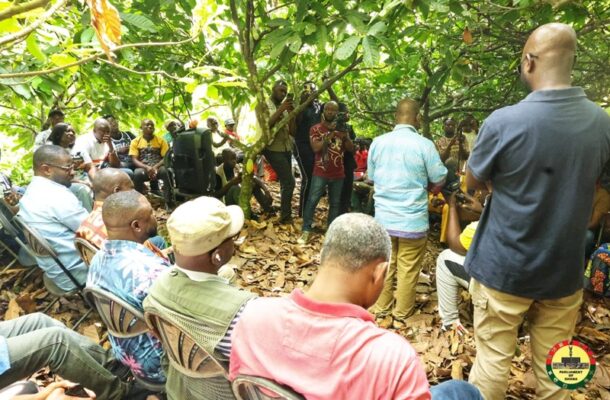
The growing discontent was laid bare during a visit by the Minority Caucus in Parliament to cocoa-growing communities in the Atwima Mponua Constituency, led by Minority Chief Whip Frank Annoh-Dompreh.
The tour, part of a broader nationwide engagement, provided a platform for farmers to voice deep frustration over the government’s decision to slash the producer price from GH¢3,625 to GH¢2,587 per bag—a reduction of about 28.6 percent.
The farmers described the move as economically devastating and insensitive, particularly at a time when input costs such as fertilizers, labour and transportation continue to rise.
Many of the farmers who spoke during the engagement said the price cut has worsened already dire conditions, with several lamenting delays in payments for cocoa beans already supplied.
They claimed that although government officials have announced the release of funds, many farmers and purchasing clerks are yet to receive payments, leaving them in financial distress.
Some said they are unable to meet basic household needs, including feeding their families, paying school fees, and accessing healthcare.
The situation has also affected cocoa purchasing clerks and licensed buyers, who say they are struggling to operate due to lack of funds from the Ghana Cocoa Board (COCOBOD).
Several buyers disclosed that they have been forced to halt purchases of cocoa beans because they have exhausted their loans and have not been reimbursed.
This has led to a breakdown in the cocoa purchasing chain, with farmers reporting that their produce is being rejected at buying centres, further compounding their losses.
In some communities such as Adiembra and Agogoso, farmers warned that the declining profitability of cocoa farming is pushing many toward illegal mining, commonly known as galamsey.
A number of farmers openly admitted they are considering cutting down their cocoa farms if viable gold deposits are discovered on their land, arguing that illegal mining now offers quicker and more reliable financial returns than cocoa farming under current conditions.
A 68-year-old licensed buyer, who has spent over three decades in the cocoa trade, said he has completely lost interest in the business due to unpaid arrears and mounting uncertainty.
The Minority Caucus, reacting to the situation, strongly criticised the government’s handling of the cocoa sector.
Annoh-Dompreh described the price reduction as a “rip-off” and insisted that farmers should not be made to bear the full burden of global market fluctuations.
He argued that government must explore alternative measures, including possible bailouts or subsidies, to cushion farmers instead of reducing their incomes.
He further questioned government priorities, particularly in light of reports that the administration is considering acquiring a new presidential jet and helicopters.
“If you can borrow to buy a jet but cannot borrow to pay cocoa farmers, then during elections the jet will go and vote for you,” Annoh-Dompreh remarked, drawing applause from farmers.
His comments reflected a broader opposition position that government spending priorities must be realigned to address urgent challenges within the cocoa sector.
Other Minority members, including Isaac Yaw Opoku, Ranking Member on Parliament’s Food, Agriculture and Cocoa Affairs Committee, warned that the situation could deteriorate further if urgent interventions are not implemented.
He alleged that there are indications of possible further price reductions and urged farmers to demand fairness and accountability from government.
Farmers across communities including Dannso and Asante Akyem Ofoase echoed similar concerns, stressing that the current producer price barely covers the cost of production.
They accused the ruling National Democratic Congress (NDC) of reneging on pre-election promises to significantly increase cocoa prices, with some recalling pledges of up to GH¢6,500 per bag. Instead, they say, the government has reduced even the price inherited from the previous administration.
The emotional toll of the crisis was evident as some farmers, including elderly women, broke down in tears while recounting their struggles.
Several warned that if the government fails to reverse the decision, they would be left with no option but to stage mass demonstrations.
Others hinted at abandoning cocoa farming altogether, describing the sector as no longer sustainable under current conditions.
The unfolding situation highlights a deepening crisis within Ghana’s cocoa sector, which remains a critical pillar of the national economy.
Comments