
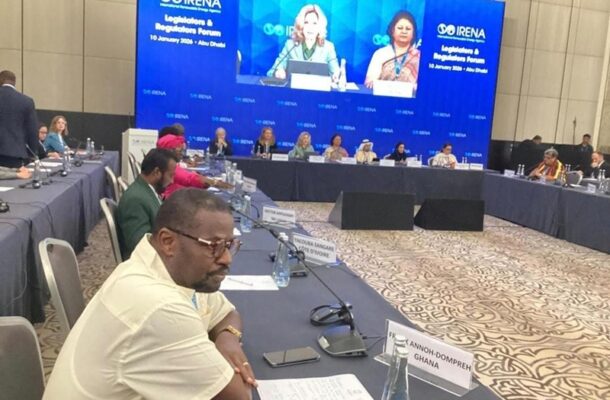
Minority Chief Whip and Member of Parliament for Nsawam-Adoagyiri, Frank Annoh-Dompreh, is representing Ghana at a high-level international dialogue in Abu Dhabi, where he is making a strong case for inclusive growth and green industrialisation as essential pillars for sustainable national and global development.
His participation places Ghana within ongoing global conversations on how emerging economies can balance economic expansion with environmental responsibility while ensuring that growth delivers tangible benefits to ordinary citizens.
Speaking at the opening ceremony of the forum, Frank Annoh-Dompreh underscored the central role of inclusive economic policies that deliberately expand opportunities for vulnerable populations, businesses, and local communities.
He stressed that growth strategies must go beyond headline macroeconomic indicators to address “bread-and-butter issues” that directly affect livelihoods, employment, and social stability.
According to him, sustainability cannot be achieved if economic transitions leave large segments of the population behind.
The Minority Chief Whip also highlighted the critical responsibility of Parliament in shaping Ghana’s transition towards a green economy. He explained that as elected representatives, parliamentarians are directly accountable to citizens and must therefore ensure that policies on energy transition, industrialisation, and climate action protect consumers, unlock jobs, and create new business opportunities.
He noted that Parliament’s oversight and legislative functions are key to embedding inclusiveness into national development frameworks.
Reflecting on the legislative history, Mr. Annoh-Dompreh pointed to amendments to existing laws to accommodate renewable energy development as evidence of Parliament’s proactive role.
He recalled that under previous governments, including the administration he served in, Ghana introduced policies to promote renewable energy and later advanced an electric vehicle policy to encourage cleaner transportation and reduce carbon emissions.
The Nsawam-Adoagyiri MP added that successive governments have continued these efforts, demonstrating a level of policy continuity in Ghana’s energy transition agenda.
He further emphasized the need for stronger private sector participation, arguing that government alone cannot finance or drive the green transition. Drawing lessons from countries such as Kenya, he cited the use of incentive mechanisms like feed-in tariffs to attract private investment into renewable energy.
Mr. Annoh-Dompreh noted that Ghana must deepen similar measures while also ensuring that rural and underserved communities are not excluded from the benefits of green industrialisation.
On the role of leadership by example, the MP called on the executive arm of government to adopt renewable energy solutions within public institutions, including the seat of government.
He argued that visible commitment by the state would send a strong signal to the private sector and accelerate broader adoption of clean energy technologies across the economy.
In concluding his remarks, Mr. Annoh-Dompreh situated Ghana’s efforts within a wider global context, stressing the importance of cooperation between the Global North and the Global South.
He noted that Africa holds an estimated 60 percent of the world’s critical minerals—such as bauxite, cobalt, and other inputs essential for renewable energy technologies like solar panels and batteries.
While the Global North possesses advanced technology and expertise, he argued that a deliberate exchange of knowledge, technology, and resources would create a mutually beneficial partnership.
According to him, such cross-fertilisation would not only advance global climate goals but also ensure that resource-rich countries in the Global South derive real developmental benefits from the green transition.
“If we focus on people, inclusiveness, and cooperation, the green transition can become a win-win for all,” he concluded, reaffirming the commitment to sustainable progress rooted in equity and shared responsibility.
Comments