
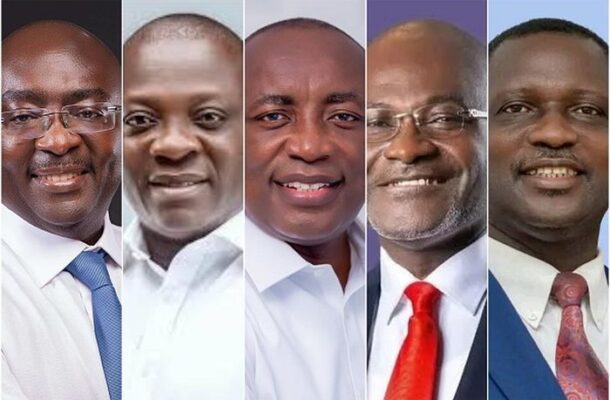
As the New Patriotic Party (NPP) approaches its much-anticipated presidential primaries scheduled for January 31, 2026, fresh empirical data from Africa Policy Lens (APL) is shedding light on the internal dynamics shaping the race.
The final poll, conducted as part of APL’s ongoing public opinion and policy research, offers a comprehensive snapshot of delegate preferences, campaign reach, and message effectiveness among the party’s grassroots leadership.
Africa Policy Lens, an independent policy research and public opinion organisation, sponsored and executed the survey between December 8, 2025, and January 23, 2026.
The data was gathered through structured telephone interviews, with a team of 12 trained field assistants operating from APL’s call centre in Accra.
Using a nationwide sampling framework, respondents were drawn from all 276 constituencies, ensuring broad geographic coverage of the party’s internal electoral college.
In total, 9,122 respondents were successfully interviewed during the polling period. APL reports a margin of error of plus or minus two percentage points at a 95 percent confidence level, underscoring the statistical reliability of the findings.
Nearly all respondents—about 99 percent—were Polling Station Executives, the core voting bloc in the NPP’s presidential primary. Only a marginal fraction comprised constituency executives, electoral area coordinators, or other party officials.
The demographic profile of respondents reflects the structure of the party’s grassroots leadership. Males accounted for 76.1 percent of those surveyed, while females made up 23.9 percent.
In terms of age distribution, the largest group fell within the 36–45-year bracket at 38.2 percent, followed closely by delegates aged 46–60 years, who constituted 33.6 percent.
Younger delegates between 25 and 35 years accounted for 20.8 percent, while those aged 18–24 formed just 0.5 percent. Delegates above 60 years represented 7 percent of respondents.
Educational attainment among delegates varied, though a significant proportion had completed secondary or post-secondary education.
According to the poll, 43.8 percent had secondary school education, 26.4 percent had post-secondary or tertiary education, while smaller proportions had middle/JHS/JSS or primary education.
Only a negligible percentage reported having no formal education.
The poll also assessed the visibility and outreach of the five presidential aspirants across constituencies.
Three candidates—Kennedy Ohene Agyapong, Dr Mahamudu Bawumia, and Bryan Acheampong—emerged as having near-universal constituency presence.
Kennedy Agyapong was reported to have visited 98.4 percent of constituencies, closely followed by Dr Bawumia at 97.9 percent and Bryan Acheampong at 82.6 percent.
In contrast, Ing. Kwabena Agyapong and Dr Yaw Osei Adutwum recorded significantly lower physical campaign reach.
Delegate engagement during these visits was notably high. About 91.9 percent of respondents indicated they were physically present when the presidential aspirants visited their constituencies, while a smaller proportion followed the campaigns through media or social media platforms. Only a negligible number reported not following the campaigns at all.
On message clarity and persuasion, the findings suggest a competitive but differentiated field. Dr Mahamudu Bawumia emerged as the candidate whose message was considered most clear and convincing, with 69.7 percent of respondents affirming this view.
Kennedy Ohene Agyapong followed with 48.3 percent, while Bryan Acheampong recorded 40.5 percent.
The remaining candidates registered minimal impact in this category, while 11.6 percent of respondents said none of the aspirants’ messages resonated with them.
When asked about the specific issues aspirants addressed effectively, party unity and reconciliation featured prominently, cited by 52.9 percent of respondents. Strategy to win national elections and support for grassroots members also ranked high, alongside policy vision for the country and internal party reforms.
These thematic priorities reflect lingering concerns within the NPP following its 2024 electoral defeat and ongoing calls for reorganisation and renewal.
Perhaps most revealing were shifts in delegate preferences before and after the aspirants’ constituency visits.
The poll shows noticeable movement, suggesting that direct engagement influenced voting intentions.
While support levels varied across candidates, Dr Bawumia recorded a significant consolidation of support after the visits, reinforcing his frontrunner status in the race.
At the same time, levels of indecision and non-commitment declined, indicating that the campaign period helped clarify choices for many delegates.
Comments