
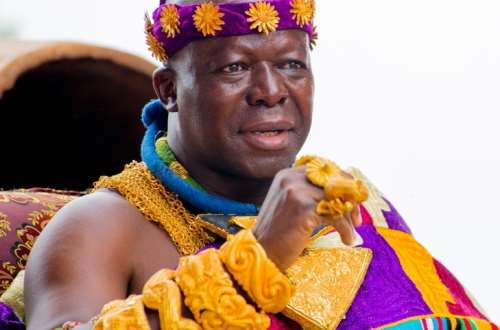
The Asantehene, Otumfuo Osei Tutu II, has firmly opposed suggestions to allow queenmothers to participate in sittings of regional and national houses of chiefs, describing the move as inconsistent with the customs and traditions of Asanteman.
While acknowledging the indispensable role queenmothers play in the chieftaincy institution—particularly in the nomination and guidance of chiefs—the Asantehene maintained that their functions, by tradition, are carried out privately rather than in public forums.
According to him, Asante custom places queenmothers at the heart of chiefly selection and counsel, but not as public representatives within the houses of chiefs.
“Our traditions recognise queenmothers as those who select chiefs and advise them behind the scenes. Chiefs, on the other hand, deliberate and speak publicly on behalf of the people,” Otumfuo stated.
He made the remarks last Friday at Manhyia Palace in Kumasi during the end-of-year meeting of the Ashanti Regional House of Chiefs.
The Asantehene’s comments followed discussions surrounding proposed amendments to the Chieftaincy Act, 2008 (Act 759), which seek to include queenmothers in the formal activities of the houses of chiefs.
Otumfuo Osei Tutu II cautioned against adopting uniform legal provisions that overlook Ghana’s diverse traditional systems, stressing that customs vary widely across ethnic groups.
“Let us not enact laws that impose one practice on all, regardless of differences in customs and traditions,” he warned.
He explained that while some societies in Ghana follow patrilineal systems, Asanteman operates a matrilineal structure, and both systems must be respected without interference.
“All of us seated here were selected by queenmothers, and we deeply respect them for that. But our tradition is clear—they advise us privately and not in the open,” he added.
The Asantehene issued a strong warning against any attempt to alter Asante customs, declaring that he would resist any measure that seeks to undermine established traditions.
“As Asantehene and custodian of the Golden Stool, I will not allow anyone to change our customs and traditions. Any rule that seeks to do so will be cancelled,” he said.
He further noted that the concept of houses of chiefs itself was not originally part of Asante culture, reinforcing his position that external structures should not be used to redefine Asanteman traditions.
“No one should attempt to introduce a rule that brings queenmothers into sittings of the house of chiefs. That will not be accepted,” he stressed.
During the same meeting, a High Court judge, Justice Hannah Taylor, formally swore in the Kwamanghene, Nana Debrah Boateng Bediako, as a full member of the Ashanti Regional House of Chiefs.
Separately, Otumfuo Osei Tutu II expressed concern over a report by the Lands Commission on encroachment around the Owabi Dam, a key water source for parts of the Ashanti Region.
He criticised state institutions, including the Lands Commission and Ghana Water Limited, for failing to prevent construction close to the dam, despite existing laws prohibiting development near water bodies.
“It is clearly established that buildings should not be put up close to water sources, yet all the relevant agencies sat by and allowed this to happen,” he noted.
The Asantehene called for stronger collaboration between traditional authorities and state agencies to protect the dam, stressing the need to safeguard it for continued water supply to the region.
“We must work together to protect the dam so it can continue to serve us,” he concluded.
Comments