

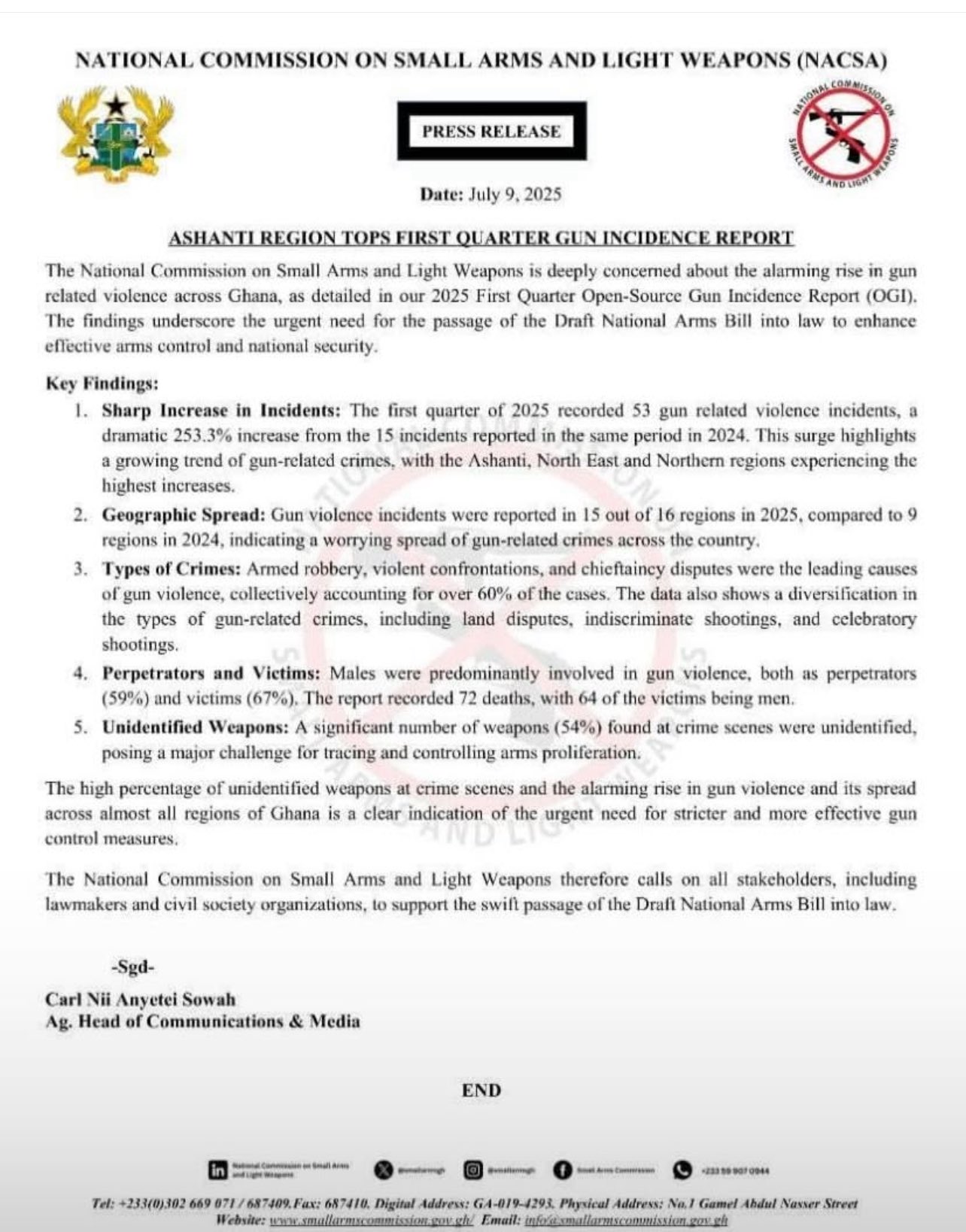
The National Commission on Small Arms and Light Weapons has expressed grave concern over a sharp increase in gun-related violence across Ghana, as captured in its 2025 First Quarter Open Source Gun Incidence Report.
The Ashanti Region has been identified as the epicenter of gun violence in Ghana for the first quarter of 2025, according to a new report by the National Commission on Small Arms and Light Weapons.
The findings point to a staggering 253.3% increase in gun-related incidents nationwide compared to the same period in 2024.
Between January and March 2025, the country recorded 53 gun violence cases, a dramatic rise from just 15 cases during the first quarter of 2024. When compared to the 47 incidents logged in the final quarter of 2024, the upward trend—though slightly moderated—shows continued escalation in armed violence.
The Ashanti Region alone recorded 12 cases, rising sharply from 3 cases in Q1 2024, making it the region with the highest number of reported incidents. Other regions that saw significant increases include the North East, Northern, Volta, and Greater Accra regions—many of which did not report any incidents during the same period last year.
Out of Ghana’s 16 regions, 15 recorded gun violence cases this year, compared to 9 regions during Q1 2024. The Upper West Region was the only area that remained incident-free.
The report categorizes the country into three zones based on incident concentration:
- Middle Zone: 45% of total incidents
- Northern Zone: 38%
- Coastal Zone: 17%
Key causes of the spike in violence include:
- Armed robbery
- Violent confrontations
- Chieftaincy disputes
These three alone accounted for over 60% of the total incidents.
The human toll of the violence was also revealed to be heavily gendered:
- 59% of perpetrators were male
- 67% of victims were male
- 64 out of 72 fatalities were men
Authorities recovered 33 firearms from crime scenes during the quarter. The breakdown includes:
- 10 empty AAA cartridges (14%)
- 7 pistols (10%)
- 5 pump-action guns (7%)
- Locally made firearms and explosives (4% each)
However, a significant concern remains: 54% of the recovered weapons could not be identified, highlighting the challenges in tracking illegal firearms in the country.
The Commission warns that the geographic spread and frequency of gun violence present an urgent national security threat, calling for targeted interventions across affected zones and improved intelligence to curb the proliferation of arms.
Comments