
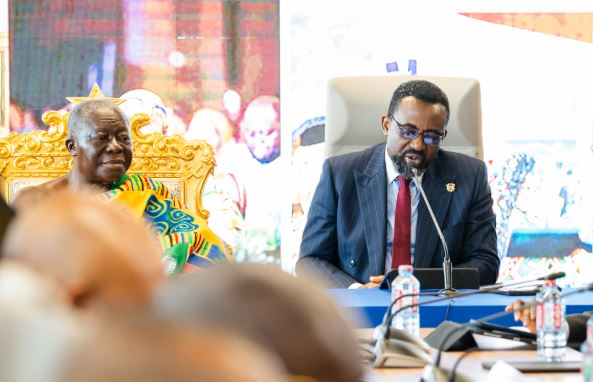
The Governor of the Bank of Ghana (BoG), Dr. Johnson Asiama, has credited sustained fiscal and monetary discipline, improved food supply conditions, and strong coordination among key state institutions for the sharp decline in Ghana’s inflation.
Speaking on Wednesday, January 7, during a courtesy visit by the Asantehene, Otumfuo Osei Tutu II, to the Bank of Ghana’s headquarters in Accra, Dr. Asiama described the progress as deliberate and policy-driven.
“Certainly, Nana, these results have not happened by accident; they are the outcome of sustained monetary discipline, improved food supply throughout 2025, and closer coordination among key policy institutions, particularly the Bank of Ghana and the Ministry of Finance,” he said.
Dr. Asiama highlighted that inflation, which stood at 23.8 percent in December 2024, had fallen steadily over the past year. “By October 2025, inflation dropped to 8 percent. In November, it declined further to 6.3 percent, and this morning, we learned that December’s rate has fallen to 5.4 percent,” he announced.
He noted that the disinflation has been broad-based, affecting both food and non-food items, which has created space for a cautious easing of monetary policy. The monetary policy rate was gradually reduced from 27 percent to 18 percent as of the November 2025 meeting, a step Dr. Asiama said was carefully sequenced to safeguard the gains achieved.
“We struck a balance between preserving hard-won disinflation gains and supporting recovery in credit and economic activity,” he explained.
The Governor also pointed to Ghana’s strengthened external position, revealing that gross international reserves have reached historic levels of over $13.8 billion, providing close to six months of import cover. “I joined the Bank in 1995 and have never seen such figures,” he said, describing the development as unprecedented in the institution’s history.
On currency performance, Dr. Asiama noted that the cedi ended 2025 stronger than expected.
“A year-end rate of about 10.67 to the US dollar placed the cedi among the stronger-performing currencies on the African continent,” he said, while cautioning that exchange rate stability must be continuously earned.
“Stability is not something that can be declared; it must be earned. A currency remains strong only when the economy beneath it is productive, competitive, and disciplined,” he added.
Dr. Asiama emphasized that sustaining these gains would require difficult national choices, including fiscal restraint, prioritising production over consumption, focusing on exports, and long-term planning.
He reaffirmed the Bank of Ghana’s commitment to protecting the progress made. “The Bank of Ghana is fully committed to acting firmly, independently, and professionally so that the gains we are beginning to see become durable and inclusive,” he concluded.
Comments