
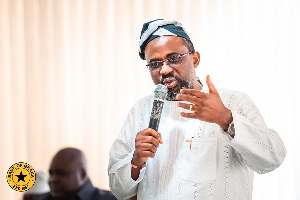
Governor of the Bank of Ghana, Dr Johnson Pandit Asiama, has underscored the country’s improving macroeconomic stability while outlining the policy trade-offs required to sustain growth and control inflation.
Speaking at the Governor’s Roundtable during the 2026 Kwahu Business Forum on Sunday, April 5, Dr Asiama highlighted Ghana’s economic progress in 2025, pointing to exchange rate stability and strong macroeconomic indicators.
“The cedi is stable and under control,” he stated.
The Governor explained that central banking decisions often involve balancing competing priorities, particularly between supporting economic growth and managing inflation.
“The work we do is always about trade-offs… trying to strike the right balance,” he said, stressing the importance of carefully calibrated policies.
Dr Asiama noted that while the economy performed strongly in 2025, the gains came at a significant cost to the central bank. He revealed that substantial resources were used to mop up excess liquidity and reduce inflation to 5.4 percent by December 2025.
“Last year was good but expensive for the central bank. It took us a lot of money to mop up excess liquidity and bring inflation down,” he explained.
However, he expressed optimism about 2026, indicating that maintaining low and stable inflation may require fewer resources going forward.
“If you look at where inflation was at the end of December 2024 and where it is now, it wouldn’t involve the same level of resources to keep it low and stable,” he added.
The Governor also emphasised the need for collaboration with the business community, noting that a strong financial sector is key to economic growth.
“When banks are strong, they can give more credit,” he said, assuring stakeholders of the central bank’s commitment to strengthening financial markets.
The Governor’s Roundtable marked the conclusion of the 2026 Kwahu Business Forum, which began on April 3 and brought together business leaders, investors, policymakers, and development partners to discuss strategies for driving economic growth.
Notable participants included Julius Debrah, Rita Akosua Adjei Awatey, Seth Terkper, and Marietta Agyeiwaa Brew.
Comments