
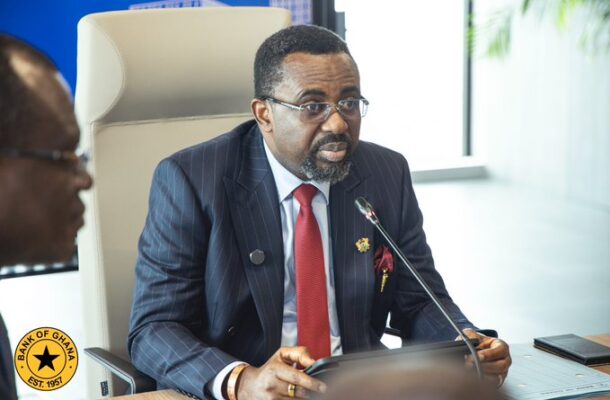
Johnson Pandit Asiama has called on the International Monetary Fund (IMF) to urgently rethink its approach to addressing Africa’s worsening economic challenges, warning that the continent is facing multiple overlapping crises that existing policy tools are too slow and limited to resolve.
Speaking at the African Consultative Group meeting held at the IMF headquarters and attended by IMF Managing Director Kristalina Georgieva, the Governor said incremental reforms would no longer be sufficient to deal with Africa’s rising debt pressures, climate shocks and tightening global financial conditions.
He noted that while the IMF continues to play a stabilising role for economies in distress, its current framework—particularly on sovereign debt restructuring—requires urgent reform.
At the centre of his message was a call for faster, more predictable debt resolution processes. He urged the Fund to exercise stronger influence under the G20 Common Framework to ensure debt workouts are completed within clear timelines and with meaningful participation from private creditors.
Dr. Asiama also raised concern that delays caused by protracted creditor negotiations are often treated the same as domestic policy shortcomings, a situation he said unfairly penalises reforming countries.
According to him, such delays deepen uncertainty, discourage investment and restrict access to international capital markets for countries already implementing difficult economic reforms.
He described the broader global economic environment as “exceptionally challenging,” pointing to high borrowing costs, fragile fiscal positions and repeated external shocks affecting many African economies.
He further highlighted spillover effects from geopolitical tensions in the Middle East, which he said are worsening inflationary pressures and weakening external balances across several countries.
While acknowledging recent IMF efforts, he called for a “step-change” in the institution’s response to overlapping global crises, including reforms to debt sustainability frameworks and greater use of the Integrated Policy Framework.
Dr. Asiama also advocated faster and more flexible deployment of emergency financing tools, especially for countries facing acute balance-of-payments difficulties and climate-related risks.
He proposed scaling up concessional financing, accelerating Special Drawing Rights reallocation, and making facilities such as the Resilience and Sustainability Trust more responsive to urgent needs.
Beyond financial reforms, the Governor emphasised the importance of continued technical assistance from the IMF in areas such as revenue mobilisation, debt management, financial sector regulation and emerging risks associated with digital assets and cybersecurity.
Comments