
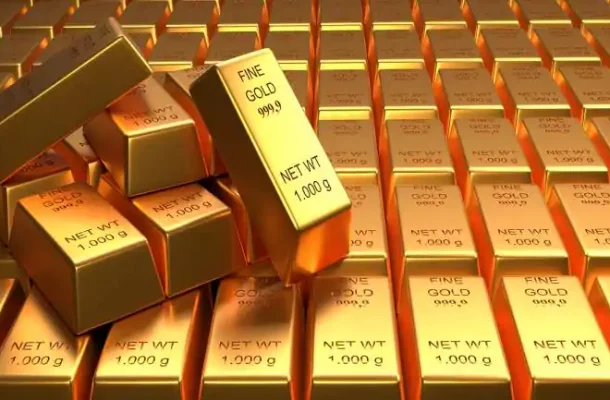
The Bank of Ghana (BoG) has cut the share of gold in its international reserves by 51 per cent and reinvested the proceeds into foreign-currency assets, prioritising yield, liquidity and diversification despite record-high global gold prices.
Governor Dr Johnson Asiama said the move represents a strategic portfolio rebalancing rather than a withdrawal from gold, stressing that the country’s reserve position has continued to strengthen.
Gold holdings declined to about 18.6 tonnes from levels that previously accounted for more than 38 per cent of total reserves as at October 2025. According to the central bank, the reduction followed concerns over concentration risk after gold holdings exceeded 40 per cent of total reserves.
“At the time, we were holding a little over 40 per cent, so the decision was made to diversify, and that is what you see,” Dr Asiama said at the 128th Monetary Policy Committee (MPC) press briefing in Accra.
“The effects that were aimed at are there. It is earning dividends and contributing to reserve accumulation,” he added.
The shift comes amid a surge in global gold prices, driven by geopolitical tensions, financial market uncertainty and sustained central bank demand. As of January 28, 2026, spot gold prices hit a record US$5,289.38 per ounce.
Despite the sale of bullion, BoG said reserves have continued to grow. Gross international reserves rose to US$13.8 billion at end-December 2025, equivalent to 5.7 months of import cover, up from US$9.1 billion, or 4.1 months, a year earlier.
Dr Asiama cautioned against assuming that current gold price levels will persist, noting that not all price drivers are permanent.
“It is true gold prices have risen to record levels, way above US$5,200. But some of the factors driving these prices are transitory and may not be permanent,” he said.
He explained that future decisions on gold holdings will be guided by structural considerations and assessments of the optimal composition of Ghana’s reserves.
The central bank plans to continue rebuilding reserves in 2026 while reviewing the appropriate balance between gold and other income-generating assets.
Gold remains central to Ghana’s external position. The country recorded a provisional current account surplus of US$9.1 billion in 2025, up sharply from US$1.5 billion the previous year, supported by strong gold exports, increased private transfers and lower services and income payments.
Gold accounted for about 67 per cent of total exports in 2025, with receipts estimated at US$20.97 billion—exceeding the US$17.5 billion spent on imports of goods. These inflows, together with capital inflows, produced a balance of payments surplus of US$3.98 billion, helping stabilise the cedi.
The currency appreciated by 40.7 per cent against the US dollar in 2025, reversing a 19.2 per cent depreciation in 2024. The BoG attributed the rebound to reserve accumulation, tight monetary policy and favourable global conditions. The cedi has remained relatively stable in early 2026.
Monetary policy easing
The gold rebalancing coincides with a shift toward monetary easing following a sharp decline in inflation. The MPC cut the policy rate by 250 basis points to 15.5 per cent in January, extending an easing cycle that delivered cumulative rate cuts of about 1,000 basis points in 2025. The effective Ghana Reference Rate for January 2026 stands at 15.68 per cent.
Inflation fell to 5.4 per cent in December 2025 from 23.8 per cent a year earlier, dropping below the BoG’s medium-term target band of 6–10 per cent.
Despite the rate cuts, Dr Asiama said the Bank maintained tight control over liquidity through sterilisation to preserve price stability. Reserve money growth slowed to 12.5 per cent in 2025 from 47.8 per cent in 2024, while broad money growth eased to 16.5 per cent from 31.9 per cent.
Balance sheet pressures
Addressing concerns about the costs of gold-related operations and broader balance sheet pressures—particularly following losses linked to the domestic debt exchange—the Governor said such costs should be viewed within the context of the central bank’s mandate.
“We are not a profit-making institution. In carrying out our mandate, yes, you will incur costs, but these are legitimate costs incurred for the public good,” he said.
He added that government has committed to recapitalising the BoG under recent amendments to the central bank law to strengthen its balance sheet.
Looking ahead, the BoG said it will continue monitoring global gold markets, financial conditions and domestic economic trends as it calibrates reserve management and monetary policy.
The reduction in gold holdings comes as the Ghana Gold Board (GoldBod) prepares to assume full operational control of the domestic gold trade in 2026. GoldBod reported over US$10 billion in revenue from artisanal and small-scale mining in 2025.
However, the International Monetary Fund has raised concerns about the financial efficiency of gold trading frameworks. In its 2025 assessment, the IMF flagged about US$214 million in quasi-fiscal losses linked to trading margins and operating fees and recommended that such costs be transferred to the national budget.
The IMF reiterated during a December 2025 review that the gold-for-reserves programme should function primarily as a buffer and stressed the need for greater accounting transparency.
Dr Asiama told Parliament that the gold-for-oil programme remains suspended pending an external audit following reported losses of GH¢2.43 billion.
He said policy in 2026 will focus on streamlining the gold-for-reserves initiative, with GoldBod operating independently to shield the central bank from risks associated with physical commodity trading.
Comments