
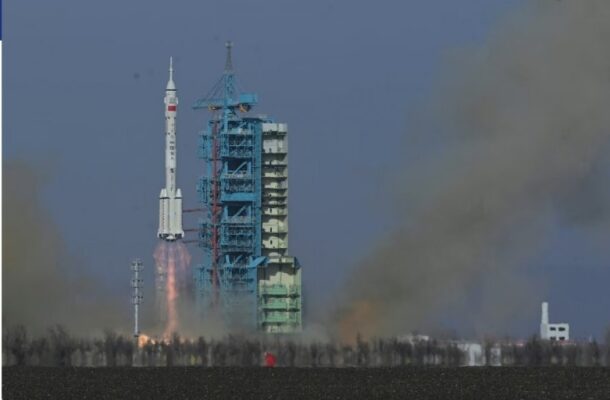
China launches Shenzhou-22 spacecraft to Tiangong space station to enhance safety after earlier orbital damage. The new mission strengthens emergency readiness and marks a key moment for China’s expanding space programme.
A Strategic Mission After an Orbital Setback
In a decisive move to reinforce the safety and resilience of its space programme, China launches Shenzhou-22 spacecraft to Tiangong space station, responding to concerns raised after a previous spacecraft was damaged in orbit earlier this month. The new mission, carried out on Tuesday, underscores Beijing’s commitment to ensuring uninterrupted operations aboard its growing orbital outpost. With the Tiangong station left without an emergency-return vehicle for ten days—a first since becoming fully operational in late 2022—the launch of Shenzhou-22 signals a renewed determination to maintain stability and preparedness in its manned spaceflight activities.
Shenzhou-22 Arrives to Replace Damaged Craft
China Launches Shenzhou-22 Spacecraft to Tiangong Space Station After Debris Incident
According to Chinese officials, Shenzhou-22 has been deployed to replace Shenzhou-21, which was forced to depart Tiangong six months ahead of schedule. The premature return followed an incident where the docked Shenzhou-20 spacecraft suffered impact damage from orbital debris. Initially, the three-person crew aboard the station had planned to return to Earth using Shenzhou-20 on 5 November, but the debris strike rendered their scheduled spacecraft unsafe. As a result, the astronauts used Shenzhou-21 as their return vehicle, leaving Tiangong temporarily without a standby emergency craft.
This rare gap in safety coverage prompted swift action, culminating in the rapid launch of Shenzhou-22 from the Jiuquan Satellite Launch Centre in north-western China.
Unmanned Mission Ensures Safety Without Overloading Crew Capacity
While previous Shenzhou missions with even-numbered designations have been manned, the decision for China to launch Shenzhou-22 spacecraft to Tiangong space station as an unmanned vehicle reflects strict capacity limits aboard the station. Only three astronauts can remain on Tiangong for extended durations, and sending an additional crewed craft would exceed operational limits.
Shenzhou-22 therefore arrives empty, serving exclusively as a replacement spacecraft designed to guarantee emergency evacuation capability for the station’s crew.
Shenzhou-23 Set for 2025 as China Expands Its Space Ambitions
China’s space programme shows no signs of slowing. Officials have confirmed that the next manned mission, Shenzhou-23, is expected to launch around April next year. The programme continues to evolve quickly as China pushes for deeper scientific research, technological experimentation, and long-term human presence in low-Earth orbit.
Longer Crew Stays After Damage to Shenzhou-20
The debris impact that damaged Shenzhou-20 forced operational adjustments aboard Tiangong. Its crew, unable to use their original return craft, had to remain on the station for an additional ten days, overlapping with the newly arrived Shenzhou-21 mission.
This overlap resulted in the station hosting six astronauts simultaneously—well above the usual rotation pattern and for longer than standard shift duration. Despite the pressure, mission controllers kept all systems running at full capacity.
Strengthening Safety for Future Missions
The decision that China launches Shenzhou-22 spacecraft to Tiangong space station serves as a strong signal of the country’s focus on reliability, safety, and long-term sustainability in orbit. Following the unexpected debris strike, the rapid deployment of a replacement vehicle reaffirms China’s determination to maintain robust emergency protocols and elevate the resilience of its space operations.
Comments