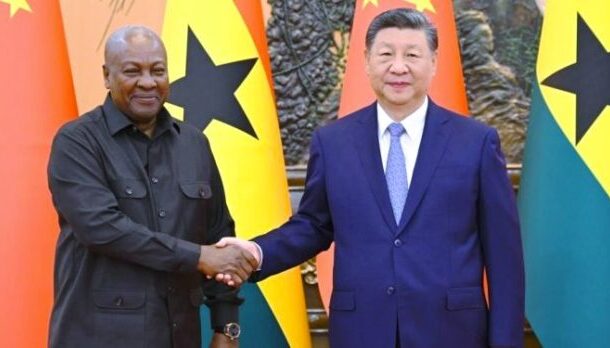
Economist Professor Godfred Bokpin has cautioned that China stands to gain significantly more from the recently announced zero-tariff trade agreement with Ghana than Ghana itself.
Speaking on JoyNews’ PM Express, Prof. Bokpin argued that the deal should be viewed primarily through China’s strategic lens, not Ghana’s.
“China needed this more,” he said. “They are trying to reduce their exposure to the U.S. market and diversify their trade base. This is part of a consistent pattern—China wants new markets, and Africa fits that agenda.”
He explained that the agreement aligns with China’s broader strategy to deepen trade ties across Africa.
“If you look at China’s trade openness with Africa, it’s very deliberate. They’re expanding strategically,” he added.
Prof. Bokpin expressed concern that the deal could worsen Ghana’s trade imbalance, given that Chinese goods already dominate local markets even with existing tariffs.
“Do you want it to get worse? Even with some level of tariffs, Chinese goods are all over the place,” he said.
He also criticised the government for failing to engage key domestic stakeholders such as the Association of Ghana Industries (AGI) and the Ghana National Chamber of Commerce before committing to the agreement.
“These are the big players—the ones doing the numbers. You needed broad-based consultation to understand how they view it,” he noted.
According to him, while the agreement may appear mutually beneficial, it largely serves China’s long-term economic goals.
“This is just a piece of a much larger strategy China has for Africa,” he said, citing a recent visit by Chinese experts to Ghana to explore investment opportunities.
When asked by host Evans Mensah whether Ghana had any real choice in the matter, Prof. Bokpin admitted that the country’s options were limited.
“We don’t have much of an option. China is a powerful trading and development partner,” he said. “Given the changing dynamics with Paris Club and non-Paris Club creditors, our leverage is very limited.”
He further argued that Africa lacks a unified strategy for engaging global trade partners.
“Have we sat down to develop one? Having the African Continental Free Trade Area doesn’t automatically mean we’re taking advantage of it,” he said. “It’s like saying Africa will win the World Cup because it has more slots—it still depends on preparation and strategy.”
Prof. Bokpin also highlighted structural weaknesses in Ghana’s economy that undermine its competitiveness.
“Our economy is import-driven. The financial system supports imports, not production,” he said. “The share of private sector credit going to agriculture and manufacturing is far smaller than what goes to services and trade.”
He concluded that without a clear national industrial strategy, agreements like the zero-tariff deal risk deepening Ghana’s dependency rather than promoting sustainable growth.
Comments