
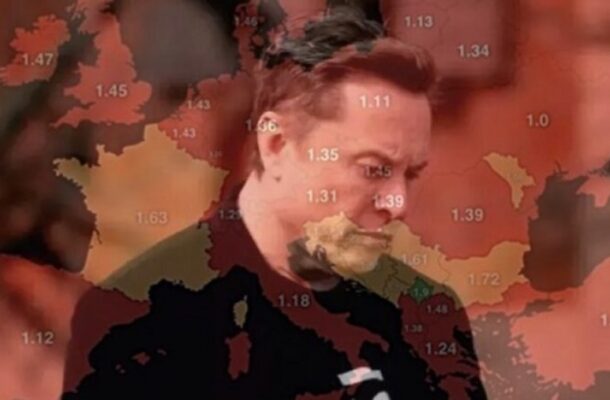
Elon Musk shares a revealing birth rate map of Europe on X, showing a widespread demographic crisis. Kosovo stands out as a rare bright spot as most of the continent falls below replacement fertility levels.
Elon Musk's Europe Birth Map Reveals Demographic Crisis
Billionaire tech mogul Elon Musk has stirred widespread debate after sharing a striking map illustrating Europe’s declining birth rates. The map, posted on his social media platform X, categorises countries by average births per woman — revealing a continent largely “in the red,” with only a few exceptions.
Musk, a vocal critic of population decline, accompanied the post with a grim warning: “Either Europe will start having big families, or it will continue to die.” His comment adds urgency to an issue demographers have long warned about — Europe’s fertility crisis and its implications for the future of the continent.
Europe’s Red Zones: Where Birth Rates Are Alarmingly Low
The map categorises countries into five tiers based on fertility rate:
-
Under 1 child per woman: "Extremely low grade"
-
Up to 1.0: "Low grade"
-
Up to 1.5: "Insufficient grade"
-
Up to 1.9: "Close to the replacement rate"
-
Above 2.1: "Above the replacement grade"
According to Musk’s map, most of Europe falls into the lowest categories, highlighting a critical shortfall in the number of children born per family. Ukraine, while embroiled in conflict, surprisingly reports an expected rate of 1.0 — barely at the "low grade" threshold.
In Western Europe, France stands out with a relatively strong fertility rate of 1.63, placing it among the better-performing nations. However, Spain (1.12), Lithuania (1.13), and Estonia (1.17) remain near the bottom of the chart, suggesting significant demographic challenges.
Kosovo and the Balkans: A Fertility Outlier
One of the most eye-catching takeaways from Musk’s map is the standout performance of Kosovo. With a birth rate of 1.9 children per woman, the small Balkan nation ranks highest in Europe and is labelled "close to the replacement rate." While still below the sustainable threshold of 2.1, Kosovo’s number is notably better than that of most of the continent.
The broader Balkan region fares comparatively well. Montenegro records a fertility rate of 1.79, while Serbia stands at 1.61 and Bosnia and Herzegovina at 1.58. Other nations showing moderate fertility include Moldova (1.66) and Bulgaria (1.72), offering a contrast to the grim figures seen elsewhere in Europe.
A Warning from Musk: Big Families or Population Decline
The Stakes of Europe's Fertility Freefall
Elon Musk’s stark commentary underscores a pressing issue: population decline and the societal strain it brings. Falling birth rates lead to ageing populations, labour shortages, and increased pressure on healthcare and pension systems. Without a demographic rebound, the economic and cultural fabric of Europe could face irreversible change.
As Twitter becomes “X” and Musk continues to use the platform for shaping global discourse, his latest message has reignited the debate over Europe’s demographic trajectory. Whether nations will respond with policy reforms and cultural shifts remains to be seen, but one thing is clear: the birth rate crisis is no longer just a statistical concern — it’s a geopolitical one.
Comments