
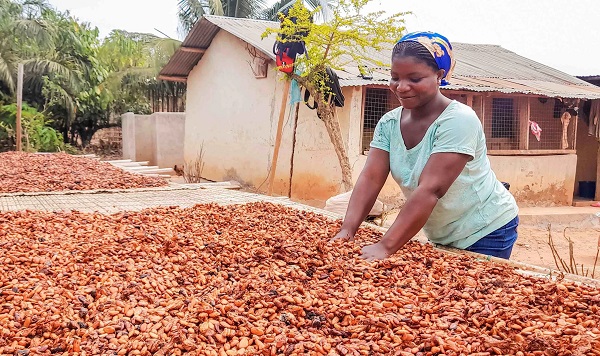
The European Union and its French development partners are urging Ghana and Côte d’Ivoire to accelerate cocoa sector reforms, citing new research that highlights the need for stronger sustainability measures to keep the industry competitive and safeguard farmer incomes.
At a two-day feedback workshop in Accra, researchers presented findings from the EU- and AFD-funded Cocoa4Future project, which explored agroforestry models, disease management, and the socioeconomic realities of cocoa farming across the two leading global producers. Organisers said the results offer clear, practical pathways for scaling sustainable practices that will help West African exporters meet increasingly strict European requirements on traceability, deforestation, and labour standards.
“The cocoa sector is the backbone of Ghana and Côte d’Ivoire,” said Professor Félix Asante, Pro Vice-Chancellor for Research, Innovation and Development at the University of Ghana. He noted that the project’s multi-year fieldwork provides robust, localised data to guide effective policy reforms. “Scientists need to involve policymakers and stakeholders; otherwise their research will not be useful for the development of the country and the sector,” he added.
EU officials underscored the urgency of action. Without swift improvements in agroforestry adoption, deforestation control, and the elimination of child labour risks, they warned that West African suppliers could struggle to meet new European rules and evolving buyer expectations.
“Cocoa connects Africa and Europe – it is our common duty to make it a driver of sustainable development, free from deforestation and child labour, ensuring decent income for producers,” said Paulina Rozycka, head of section for infrastructure and sustainable development at the EU Delegation.
Findings from Cocoa4Future reveal deepening challenges within the sector. Researchers highlighted aging farms, declining yields and the accelerating spread of cocoa swollen shoot virus disease—problems that heighten production risks even as international prices fluctuate sharply. Comparative trials between monoculture and agroforestry systems showed that diversified, shade-integrated farms offer stronger resilience to pests, climate shocks and market volatility while supporting household food security.
Throughout the workshop, partners and donors pushed for concrete policy measures. Key recommendations included expanding access to certified shade-tree seedlings, improving extension services, clarifying tree-ownership rights within agroforestry systems, and strengthening rehabilitation and compensation schemes for farms infected by swollen shoot disease. They also called for increased investment in resistant planting materials and more funding for CSSVD research.
“Agroecology and good governance go hand in hand,” said Clémentine Dardy of the French Development Agency (AFD), emphasising that financing and technical support must be aligned with scientific evidence. She said the project has produced “practical solutions that can make a real difference on the ground,” including assisted natural regeneration and integrated mixed-crop systems that reduce farmers’ vulnerability.
The recommendations reflect a shift away from large, state-led plantation initiatives toward farmer-centred approaches—such as on-farm diversification into crops like coconut, avocado and coffee, and restoring degraded farms through natural regeneration. Researchers stressed that empowering smallholders with the right tools, knowledge and support will yield better environmental and livelihood outcomes than top-down land-conversion programmes.
Comments