
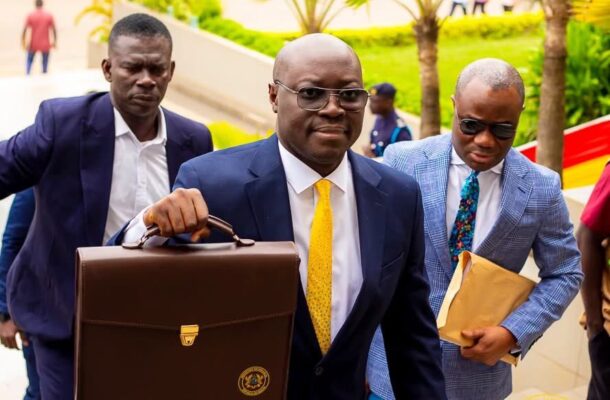
Finance Minister Dr. Ato Forson is expected to present the 2026 Budget Statement and Economic Policy to Parliament on November 13, 2025, Joy Business has learned from sources close to the process.
The proposed date, which awaits parliamentary approval, will mark the government’s first full-year budget since winning the 2024 general elections and assuming economic management responsibilities for nearly nine months.
Observers note that the 2025 Budget largely followed the fiscal framework established by the previous administration, making the upcoming presentation a key opportunity for the new government to outline its own economic direction.
Under the Public Financial Management Act, the Finance Minister—acting on behalf of the President—must present the national budget to Parliament no later than November 15 each year.
The Finance Ministry has reportedly concluded several rounds of stakeholder engagements and industry consultations to finalise the policy measures and programmes to be featured in the 2026 Budget.
Dr. Forson has previously indicated that the budget will prioritise job creation and economic growth stimulation, positioning it as a roadmap for post-crisis recovery and private sector revitalisation.
Sources close to the Ministry suggest that the Finance Minister will unveil new tax policy reforms aimed at improving revenue mobilisation while easing the burden on businesses and households.
According to Ghana Revenue Authority (GRA) Commissioner-General Anthony Sarpong, the budget will include a review of the Value Added Tax (VAT) regime, with the effective rate expected to be reduced from 22% to 20%.
The adjustment forms part of broader efforts to simplify the VAT structure and make it more business-friendly.
Additionally, Dr. Forson is expected to review several existing levies, including the COVID-19 levy, as part of the government’s plan to streamline the tax system and support economic activity.
With Ghana expected to exit the IMF programme in May 2026, attention will focus on how the Finance Minister plans to navigate the post-programme period—balancing growth priorities with fiscal discipline.
The 2026 Budget is, therefore, seen as one of the government’s most significant economic policy statements, setting the tone for macroeconomic management, deficit control, and expenditure rationalisation beyond the IMF framework.
Economists and industry players will be watching closely to see how Dr. Forson intends to manage public finances, sustain macroeconomic stability, and accelerate growth in what is expected to be a defining budget for the administration.
Comments