
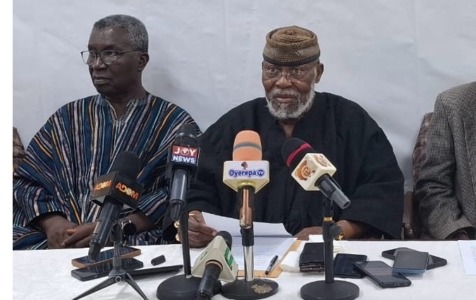
Two leading figures of the New Patriotic Party (NPP) — Professor Kwabena Frimpong-Boateng and Dr Nyaho Nyaho-Tamakloe — together with a senior member of the National Democratic Congress (NDC), Dr Christine Amoako-Nuamah, have filed a landmark case at the Supreme Court challenging how political parties in Ghana choose their presidential and parliamentary candidates.
Invoking the court’s original jurisdiction, the three are seeking constitutional clarity on whether the delegate-based systems widely used by major political parties comply with democratic principles enshrined in the 1992 Constitution.
The plaintiffs, represented by lawyer Oliver Barker-Vormawor, argue that current internal party elections unfairly restrict participation by limiting voting rights to selected delegates and executives, thereby excluding the majority of ordinary party members.
Their suit names the NPP, NDC, Convention People’s Party (CPP), the Electoral Commission, and the Attorney-General as defendants.
In their filing, the plaintiffs maintain that candidate selection is a core part of a political party’s internal organisation under Article 55(5) of the Constitution and must reflect genuine democracy, equal participation, and fairness.
They are asking the Supreme Court to declare that all registered members of political parties are constitutionally entitled to vote directly and meaningfully in the choice of presidential and parliamentary candidates.
According to them, true internal democracy requires broad participation, leadership accountability, and voting systems that are as direct and equal as possible — not restricted to a privileged few.
The suit specifically targets the Electoral College and Extraordinary Delegates Conference models used by the major parties, arguing that these structures effectively disenfranchise grassroots members and violate constitutional guarantees.
Beyond declarations, the plaintiffs are seeking orders compelling the NPP, NDC and CPP to amend their party constitutions to introduce open, inclusive candidate selection processes that give equal voting rights to all members in good standing.
They also want the Electoral Commission to be mandated to supervise and enforce compliance with these democratic standards during internal party elections.
The case further argues that restricting participation to a narrow group of delegates breaches the spirit and provisions of the Constitution — including the Preamble and Articles 1, 17, 33(5), 42 and 55(5) — which safeguard equality, political rights, and democratic governance.
Filed-Version-SC-writ-Plfs.-Frimpong-Nyaho-Tamakloe-and-Amoako-Nuamah-copy
Comments