
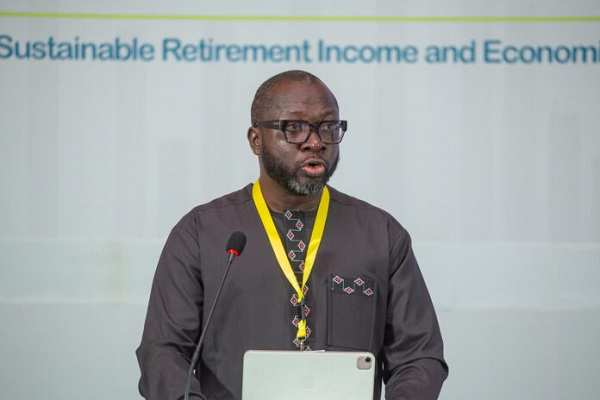
The Chief Executive Officer of the Ghana Association of Bankers (GAB), John Awuah, has attributed the sharp decline in Ghana’s Reference Rate (GRR) to policy measures implemented by the Bank of Ghana to stabilise the economy.
The GRR has fallen significantly from 29.73 percent in early 2025 to 14.58 percent, following a series of monetary policy interventions by the central bank. At its 128th Monetary Policy Committee press briefing on January 28, 2026, the Bank of Ghana further reduced the policy rate from 18 percent to 15.5 percent, a move that contributed to the continued decline in the reference rate.
Despite this development, lending rates remain relatively high, prompting businesses and households to call for further reductions to ease borrowing costs.
Speaking in an interview, Mr. Awuah explained that lending rates are largely influenced by the risk profile of borrowers, resulting in variations in loan pricing among customers.
“As the Ghana Reference Rate declines, lending rates are also expected to reduce, and that is what we have observed over the past few months,” he said.
He noted that borrowers with strong credit histories and stable income streams are more likely to secure loans at lower interest rates, while higher-risk borrowers typically face higher charges.
“Lending rates go beyond the cost of funds and include a risk premium. Depending on a customer’s credit profile, one borrower may obtain a loan at 17 percent, while another may be charged 20 or even 23 percent. There cannot be a uniform lending rate for all customers,” Mr. Awuah explained.
He added that lending rates are expected to ease further, falling from about 23 percent to around 17 percent in the coming days, a development he believes will help businesses access cheaper credit and stimulate economic activity.
Comments