
Ghana is consolidating its position as a climate leader in Africa through targeted diplomacy and coordinated government action aimed at advancing sustainability and building resilience against climate impacts.
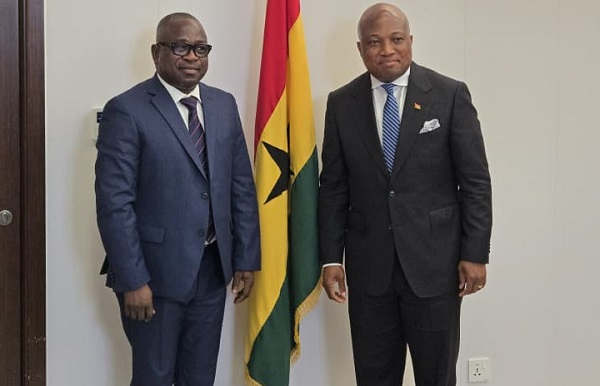
This commitment was underscored during a working visit by the Minister of State in charge of Climate Change and Sustainability, Seidu Issifu, to the Minister for Foreign Affairs, Samuel Okudzeto Ablakwa. The engagement sought to strengthen institutional alignment and deepen collaboration with international partners around Ghana’s climate agenda.
The meeting forms part of a broader effort by the newly established Office of the Minister of State in Charge of Climate Change and Sustainability (OMSCCS) to harmonise climate action across government institutions, foreign missions and development partners.
Addressing the meeting, Issifu outlined the vision and mandate of his office, stressing that effective climate action depends on cross-sector collaboration, strong diplomatic engagement and strategic partnerships. He highlighted key initiatives underway, including the creation of an Inter-Ministerial and Agency Technical Working Group bringing together government bodies, civil society organisations and the private sector to coordinate climate interventions.
He also announced plans to establish a National Climate and Sustainability Hub to centralise climate data, research, financing and capacity-building, alongside efforts to institutionalise Climate Change and Sustainability Units across public sector agencies to embed climate considerations into national development planning.
Issifu emphasised the need to fully leverage Ghana’s diplomatic platforms—particularly embassies and foreign missions—to advance the country’s climate interests and attract new sources of climate finance.
Financing the green transition featured prominently in the discussions. The Minister of State pointed to carbon credit markets as emerging revenue opportunities and advocated debt relief measures to support African countries that are heavily indebted yet disproportionately affected by climate change. He argued that flexible financing arrangements and debt forgiveness would create the fiscal space needed to scale up climate adaptation and mitigation efforts.
In response, Foreign Affairs Minister Samuel Okudzeto Ablakwa praised Issifu’s leadership and welcomed the establishment of the OMSCCS, noting that Ghana’s proactive stance has already earned global recognition. He assured the Climate Minister of his ministry’s full support.
Ablakwa also described Issifu’s appointment to the Climate Vulnerable Forum (CVF) as a significant milestone that strengthens Ghana’s standing in international climate diplomacy.
Both ministers agreed on a clear roadmap to deploy Ghana’s embassies and diplomatic missions as platforms for climate advocacy, financing and partnerships. Priority areas identified include global climate representation, mobilisation of climate finance and technology, international capacity-building, promotion of green investments and support for carbon markets under Article 6 of the Paris Agreement.
The enhanced collaboration is expected to boost climate finance inflows, strengthen Ghana’s preparedness for major global climate engagements and raise the country’s profile in international climate governance.
The working visit marks an important step in aligning Ghana’s foreign policy with climate resilience and sustainability, firmly embedding environmental priorities at the core of the country’s diplomatic agenda.
Comments