
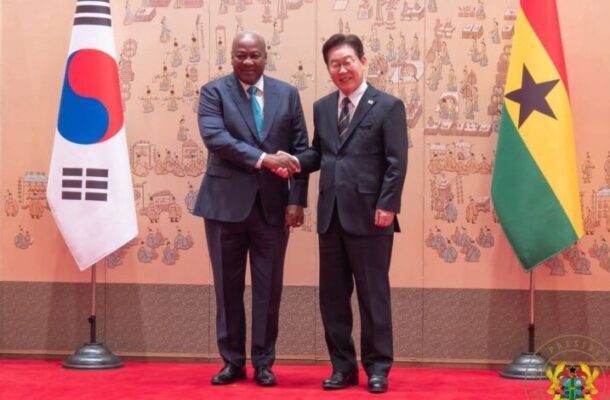
Ghana and the Republic of Korea have taken a significant step toward strengthening global climate action by signing a new cooperation agreement to address climate change and promote sustainable development.
The agreement was reached during bilateral talks between President John Dramani Mahama of Ghana and President Lee Jae Myung of South Korea, where both leaders reaffirmed their commitment to deepening collaboration on climate resilience, green technology, and environmental sustainability.
The climate cooperation agreement was among three Memoranda of Understanding signed during the meeting, alongside partnerships in maritime security and digital technology.
Speaking after the talks, President Mahama emphasized the importance of international partnerships in confronting the global climate crisis, noting that developing countries like Ghana remain highly vulnerable to the impacts of climate change despite contributing minimally to global greenhouse gas emissions.
He stressed that stronger collaboration with technologically advanced partners such as South Korea would help Ghana accelerate its transition toward climate-resilient development.
The partnership is expected to support initiatives in areas such as renewable energy development, climate adaptation, sustainable agriculture, and environmental protection.
President Mahama highlighted the role of technological innovation in addressing climate challenges, expressing optimism that Korea’s expertise in green technologies and digital solutions could support Ghana’s efforts to manage climate risks while pursuing economic growth.
He also underscored the importance of international cooperation in meeting global climate commitments, particularly within frameworks such as the Paris Agreement, where both countries have pledged to reduce emissions and strengthen climate resilience.
South Korea has increasingly positioned itself as a global leader in green technology and climate finance, while Ghana has been pursuing ambitious policies to expand renewable energy, protect its forests, and build resilience against climate-related threats such as drought, flooding, and coastal erosion.
Beyond climate mitigation, the new cooperation framework is expected to enhance capacity building, knowledge sharing, and investment in climate-smart infrastructure.
President Mahama said the partnership demonstrates how collaboration between emerging economies and advanced industrial nations can produce practical solutions to the global climate challenge.
He expressed confidence that Ghana’s natural resources and growing renewable energy potential, combined with Korea’s technological expertise, could create a model for sustainable and inclusive development.
The agreement signals a broader commitment by both countries to contribute meaningfully to international climate action while promoting economic transformation and environmental sustainability.
Comments