
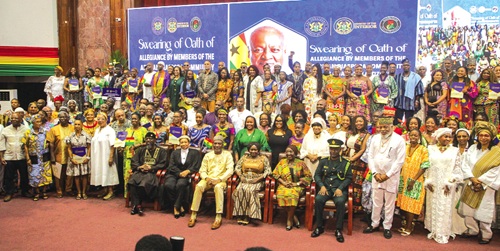
The government of Ghana has officially granted citizenship to 155 members of the African diaspora at a colourful ceremony held in Accra International Conference Centre.
The new citizens, waving miniature Ghana flags and dressed in a mix of traditional and formal attire, took the Oath of Allegiance administered by Circuit Court Judge Annette Sophia Essel, formally pledging loyalty to the republic.
Certificates of citizenship were later presented to them by the Vice-President, Naana Jane Opoku-Agyemang, with support from government officials.
The event was attended by ministers of state, members of the diplomatic corps and representatives of diaspora communities.
The ceremony forms part of Ghana’s broader effort to strengthen ties with people of African descent across the world and deepen engagement with the global African diaspora.
Addressing the gathering, Prof. Opoku-Agyemang said the conferment of citizenship represented more than a legal process, describing it as a symbolic affirmation of identity, history and belonging.
According to her, the ceremony reflected the enduring connection between Africa and its descendants around the world, noting that historical events may have scattered Africans across continents but could not erase their identity or ancestral ties.
She also referenced the painful legacy of the Transatlantic Slave Trade, describing it as one of the darkest chapters in human history.
“The history of the transatlantic slave trade remains one of the darkest chapters in human civilisation,” the Vice-President said, adding that Ghana is advocating at the United Nations for the trade to be formally recognised as one of the gravest crimes against humanity.
She explained that Ghana’s efforts at the global body are aimed at promoting truth, remembrance, justice and restoration for people of African descent worldwide.
Prof. Opoku-Agyemang further emphasised that granting citizenship to members of the diaspora represents an act of historical restoration and reconnection, reaffirming Ghana as a home for people of African heritage.
She noted that the diaspora constitutes one of the largest reservoirs of talent, innovation and economic strength available to the African continent.
According to her, diaspora communities contribute billions of dollars to African economies annually through remittances, investments, entrepreneurship and philanthropy, supporting families and driving development.
However, she stressed that Ghana’s engagement with the diaspora goes beyond economic interests, highlighting the importance of identity, belonging and shared destiny.
The Vice-President added that the government is strengthening a comprehensive Diaspora Engagement Policy designed to transform historical connections into practical partnerships.
The initiative aims to create opportunities for diaspora investment, promote entrepreneurship and encourage collaboration in areas such as education, innovation, tourism and national development.
The Minister for the Interior, Muntaka Mohammed-Mubarak, said the ceremony marked the successful completion of a rigorous legal and administrative process through which individuals with strong ties to Ghana acquired citizenship.
He explained that the Ministry for the Interior and its partner institutions remain committed to ensuring that the citizenship acquisition process is transparent, credible and consistent with Ghana’s laws.
According to him, the conferment grants the new citizens the rights and protections guaranteed under Ghanaian law, while also entrusting them with the responsibilities that accompany citizenship.
Mr. Mohammed-Mubarak described the diaspora as Ghana’s 17th region and Africa’s sixth region, emphasising that its expertise, investments, innovation and cultural connections are vital for national development and international engagement.
He also highlighted several initiatives aimed at strengthening Ghana’s relationship with the diaspora, including PANAFEST, Joseph Project, Year of Return and Beyond the Return.
He added that frameworks such as the Diaspora Birthright Certificate are helping to build structured partnerships between Ghana and its global diaspora community.
“The global community acknowledges slavery as a crime against humanity. Ghana is proud to play a leading role in reconnecting Africa with its global family, demonstrating that citizenship can serve not only as a legal status but also as a bridge linking history, identity and a shared future,” the minister said.
Comments