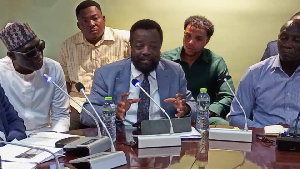
The Parliamentary Committee on Lands and Natural Resources has held a high-level public hearing on Ghana’s lithium agreement, bringing together government representatives, industry experts, civil society organisations, and citizens to deliberate on the country’s emerging critical minerals sector.
Among the notable contributors was Dr. John Kpikpi, the 2024 presidential candidate of the Progressive Alliance of Ghana (PAG), who used the platform to call for a bold rethinking of Ghana’s ownership and bargaining power in mineral resource contracts.
Dr. Kpikpi voiced disappointment with the trajectory of current negotiations, arguing that Ghana must shift from being treated as a subordinate player to asserting itself as the principal stakeholder in the exploitation of its lithium deposits. He criticised the entrenched practice where foreign companies retain controlling stakes, while Ghana—despite owning the mineral resources—receives only marginal shares.
“Up until now, we’ve been treated as though we are coming to the negotiating table empty-handed, while companies arrive with $100 million and ‘generously’ offer us 5% or 10%. No. We own the resource and the value it carries. That must count,” he argued.
Proposing a different framework for equity allocation, Dr. Kpikpi suggested that Ghana’s in-ground resource value should constitute its stake in any partnership.
“So, if the resource is worth $90 billion and a company invests $10 billion, that reality—not arbitrary percentages—should form the basis of negotiations. From that moment, we call the shots,” he said.
He maintained that such an approach would reposition Ghana as the lead negotiator, ensure greater economic returns, and reshape the governance of the mining sector in favour of national development.
Beyond equity stakes, Dr. Kpikpi called for aggressive investment in local skills, technical know-how, and entrepreneurship to strengthen domestic participation in mining operations.
“We must help our people rise—acquiring skills, techniques and entrepreneurial capacity to organise these mines. Mining is not beyond us,” he said.
He also pointed to what he described as significant capital flight under existing multinational-dominated models.
“As we speak, about $80 billion has leaked from Ghana over the last decade because of these kinds of arrangements. That is why I expected we would already be pursuing an agreement that flips the structure—one in which Ghana holds 90% ownership,” he added.
Dr. Kpikpi concluded by emphasising that with strategic leadership and an empowered workforce, Ghana can lease equipment, hire technical expertise, and take command of its mineral wealth rather than remain bound by longstanding unequal partnerships.
Comments