
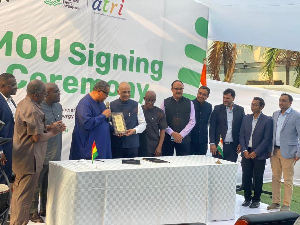
The government, through the 24-Hour Economy and Accelerated Export Development Secretariat, has signed a Memorandum of Understanding (MoU) with ATRI Energy Transition Private Limited, an India-based company specialising in renewable energy and mobility solutions.
The agreement is expected to create about 160,000 direct and indirect jobs under a new renewable energy partnership designed to support round-the-clock economic activity in Ghana.
Speaking at the signing ceremony in Accra on March 5, 2026, the Presidential Advisor on the 24-Hour Economy, Goosie Tanoh, said the deal marks the first in a series of joint development arrangements aimed at delivering up to 2,000 megawatts of renewable energy to Ghana’s national grid over the next five years.
He explained that the projects would include the development of about 40,000 hectares of grass plantations, the establishment of solar parks, the creation of agro-ecological zones, and other value chain activities connected to energy and transport infrastructure.
Mr. Tanoh noted that the projected employment opportunities would arise from several large-scale initiatives to be rolled out under the partnership.
He further indicated that the programme has introduced cost limits for electricity generation to ensure affordable power for businesses operating under the 24-hour economy initiative.
“These initiatives are targeting structured, affordable, and sustainable power for the multi-economic corridor under the 24-hour economy programme. Our tariff regime mandates that if the system includes battery storage, we cap the cost at seven cents per kilowatt-hour. Without storage, we aim to keep the cost within four to five cents, which is significantly lower than the current average of about 15 cents,” he said.
For his part, the Founder of ATRI Energy Transition Private Limited, Sammidi Kishore, expressed optimism about the partnership with Ghana.
He revealed that the company plans to establish a 20-tonne-per-day biofuel plant, develop a 100-megawatt solar installation, and roll out mobility initiatives, including the conversion or deployment of between 500 and 1,000 electric buses within the next 24 months.
Mr. Kishore added that the collaboration also provides an opportunity to harness the agricultural and hydrological potential of the Volta Basin to support large-scale biofuel production.
Comments