
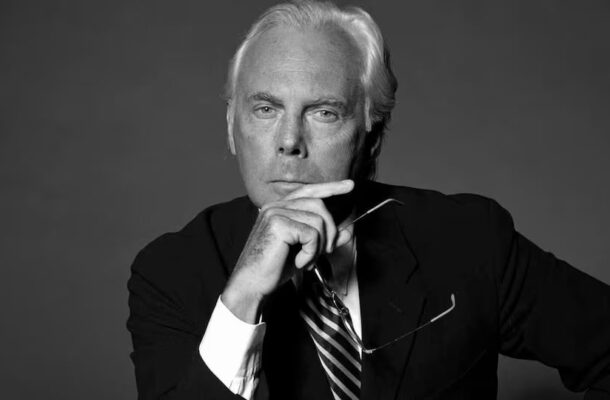
Italian fashion icon and billionaire designer Giorgio Armani has died at the age of 91, leaving behind a timeless legacy that redefined global style and elegance.
Armani, hailed as the archetype of Italian sophistication, revolutionised men’s and women’s suits by stripping away excess and tailoring them for the modern era.
His influence extended far beyond the runway, as the Armani brand grew into a global powerhouse spanning beauty, fragrance, music, sport, and even luxury hotels—generating revenues of more than £2 billion annually.
In a statement released on the brand’s official Instagram page, Armani was remembered as “indefatigable to the end,” noting that he worked until his final days “dedicating himself to the company, the collections, and the many ongoing future projects.”
The tribute described him as “driven by relentless curiosity and a deep attention to the present and to people.”
The designer’s pioneering vision not only elevated red carpet fashion to its current prominence but also reshaped the industry’s standards.
In 2006, following the tragic death of Brazilian model Ana Carolina Reston from anorexia nervosa, Armani became the first designer to ban underweight models from the runway—a move widely praised as a progressive step in fashion.
Donatella Versace was among the first to honour him, writing on Instagram: “The world lost a giant today, he made history and will be remembered forever.”
Armani’s final runway appearance came in January 2025, when he shared the spotlight with Latvian model Agnes Zogla—an image that now serves as a poignant reminder of his lifelong devotion to fashion.
Career Timeline of Giorgio Armani
- 1934 – Born on July 11 in Piacenza, northern Italy.
- 1960s – Began his fashion career working for department store La Rinascente and later as a designer for menswear brand Nino Cerruti.
- 1975 – Founded the Giorgio Armani company with his business partner, Sergio Galeotti.
- 1980s – Achieved international fame after designing costumes for Hollywood films such as American Gigolo (1980), which showcased his sleek suits worn by Richard Gere. His minimalist yet luxurious style became a global phenomenon.
- 1990s – Expanded Armani into fragrances, cosmetics, and sports, while building a network of boutiques worldwide.
- 2000s – Ventured into hospitality with the launch of Armani Hotels in Dubai and Milan, cementing his status as a lifestyle mogul.
- 2006 – Became the first major designer to ban underweight models from the runway, setting a new ethical standard in the fashion industry.
- 2010s–2020s – Continued to dominate luxury fashion, while remaining hands-on with design well into his later years.
- 2025 – Presented his final runway show in January, marking the end of an era.
Legacy & Influence
Giorgio Armani’s legacy stretches far beyond fashion.
He redefined the image of modern power dressing, giving confidence and elegance to men and women across generations.
His tailored suits became synonymous with authority in business, politics, and cinema, while his red carpet creations set new benchmarks for Hollywood glamour.
As a businessman, Armani built one of the world’s most successful independent fashion empires, maintaining creative control and steering the brand’s expansion without compromising its identity.
His pioneering moves—such as blending fashion with hospitality and lifestyle—reshaped how luxury brands operate today.
Culturally, Armani’s work bridged Italy and the world, making “Made in Italy” a global standard of excellence. He inspired countless designers and continues to influence trends decades after his rise.
Even in his passing, Armani leaves behind not only an empire but also a philosophy: that elegance is timeless, simplicity is powerful, and style is a language of its own.
Comments