
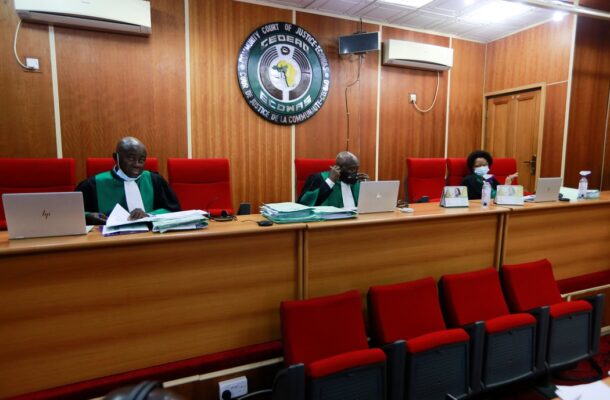
The National Democratic Congress Government has announced it will oppose an application for default judgment filed by the dismissed Chief Justice Gertrude Araba Torkornoo at the ECOWAS Court of Justice, deepening the legal tussle over her controversial suspension and subsequent removal from office.
Deputy Attorney-General, Dr. Justice Srem Sai, confirmed in an interview on Thursday, September 4, 2025, that the state is preparing a response to prevent the regional court from granting judgment in Torkornoo’s favour.
Torkornoo’s Petition To ECOWAS Court
Chief Justice Gertrude Araba Torkornoo, who was suspended earlier this year and eventually dismissed by President John Dramani Mahama on Monday, turned to the ECOWAS Court in Abuja, arguing that her constitutional rights had been violated.
She maintains that the process leading to her suspension was unconstitutional and denied her the right to a fair hearing.
As part of her suit, she is asking the court to order her reinstatement and award her $10 million in damages.
Following her removal, the former CJ intensified her case, filing fresh applications at ECOWAS, including one seeking default judgment on the grounds that the Attorney-General failed to file a defence within the stipulated 30-day period required under the court’s rules.
Her lawyers filed the processes on Wednesday, September 3, insisting that the state’s failure to respond amounted to non-compliance.
Attorney-General Defends Delay
Srem Sai explained that the Attorney-General’s office deliberately held back its defence because it had already challenged the jurisdiction of the ECOWAS Court to hear the matter.
“Our position is simple,” he stated. “If we objected to jurisdiction and the court has not ruled on that objection, then the substantive matter is premature. The court must first determine whether it even has the authority to hear the case before we can proceed with any defence.”
According to him, the state expected the ECOWAS Court to give directions after hearing arguments on jurisdiction in June 2025. Instead, the court adjourned indefinitely without issuing a ruling.
“It is only this week that we woke up to a fresh process, with the former Chief Justice now seeking judgment in default of defence. But in our view, if the court had wanted us to file a defence alongside our jurisdiction objection, it would have ordered so,” he stressed.
Jurisdiction Battle
The NDC government’s objection rests on the argument that the ECOWAS Court cannot interpret Ghana’s Constitution, a power reserved exclusively for the country’s Supreme Court.
Justice Srem Sai reiterated this point, noting: “The ECOWAS Court does not have the authority to assume jurisdiction over matters which are already before the Supreme Court of Ghana, particularly constitutional interpretation.”
The ECOWAS Court is yet to deliver its ruling on this jurisdictional challenge. Until that decision is made, the government insists it cannot be compelled to address the substantive claims of the former Chief Justice.
Wider Implications
Justice Torkornoo’s removal has sparked a national debate about judicial independence and executive overreach.
Critics, including opposition parties and sections of civil society, have described her dismissal as a dangerous precedent that undermines the separation of powers.
The government, however, has defended its actions, citing alleged misconduct and constitutional breaches on her part.
However, as the standoff shifts to the ECOWAS Court, the case is expected to test the balance of power between domestic constitutional authority and regional human rights jurisdiction.
For now, the legal battle remains unresolved, with both sides waiting for the ECOWAS Court’s next move.
Comments