The government is positioning the Ghana Labour Exchange Programme (GLEP) as a major tool to curb rising youth unemployment and boost foreign exchange earnings, with plans to export between 800,000 and one million skilled and unskilled workers over the next three to four years.
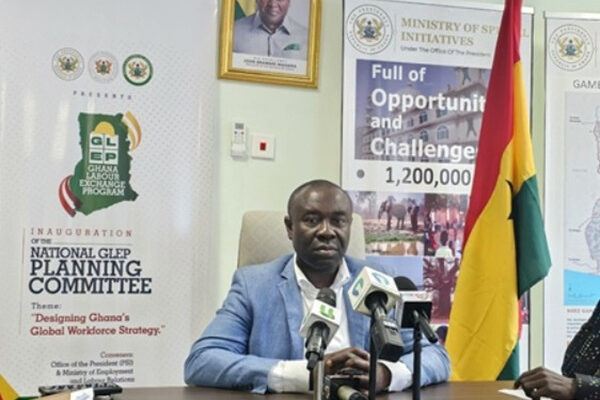
Addressing the media in Accra, Minister of State for Special Initiatives Emmanuel Kwadwo Agyekum said the programme has the potential to generate over US$10 billion annually, noting that such inflows would significantly ease the country’s fiscal pressures.
“I’m looking at more than US$10 billion coming into this country—probably three times the IMF bailout. This is something that can easily be done,” he said.
He argued that labour export offers a sustainable path to easing Ghana’s long-standing debt challenges, pointing out that the country has sought IMF assistance 17 times since independence and is currently under a US$3 billion programme ending in 2026. He added that the projected earnings from GLEP could surpass revenue from traditional exports such as cocoa and gold.
Bank of Ghana Governor Dr. Johnson Pandit Asiama supported the programme’s economic logic, noting that gold alone has earned Ghana about US$8 billion since the launch of the GoldBod initiative in March—contributing to a rise in international reserves to US$12 billion and a 37 percent appreciation of the cedi year-to-date.
The minister also cited global examples to highlight the potential scale of labour export. The Philippines earns around US$135 billion annually from overseas workers, while India generated US$130 billion in 2023. In Africa, Egypt earned US$35 billion—more than revenue from the Suez Canal—while Kenya made over US$5 billion.
According to Agyekum, the GLEP is a key initiative of President John Mahama designed to reduce unemployment, build skills, and inject substantial forex into the economy. Responding to critics who say labour export encourages “brain drain,” he described the initiative as “brain gain.”
“You cannot stop it. We live in a global village,” he said, explaining that workers who travel abroad often return with improved skills, habits, and experience. He claimed that “80–90 percent” of exported workers eventually return to Ghana.
GLEP will target both highly skilled and unskilled workers. Professions in high demand include doctors, nurses, lab technicians, pharmacists and IT specialists. Opportunities also exist for carpenters, steel benders, bricklayers, welders—especially for industries such as shipbuilding—as well as farmhands, helpers, labourers and ship workers who can be trained in as little as six weeks.
Agyekum said global demographic shifts, including ageing populations in the West and Asia, are creating immediate demand for youthful labour. He revealed that between 1,000 and 2,000 nurses are currently being recruited for specific destinations, while 654 drivers have already been hired for one country. He did not disclose the full list of receiving nations.
The minister added that government is working to streamline travel processes and ensure workers’ safety. Dedicated labour desks will be established at various embassies to address concerns and expedite documentation. Government is also signing MoUs with host countries to safeguard workers’ rights.
He said some job seekers will receive training before deployment, with initial contracts ranging from nine months to two years—after which workers may return home or renew their contracts.
Agyekum emphasised that his ministry will collaborate with other government agencies to ensure the programme fulfils its mandate of reducing unemployment, protecting Ghanaian workers abroad, and generating much-needed foreign exchange.
Comments