














GRDA warns of rising safety risks after train kills six goats on Tema–Mpakadan line
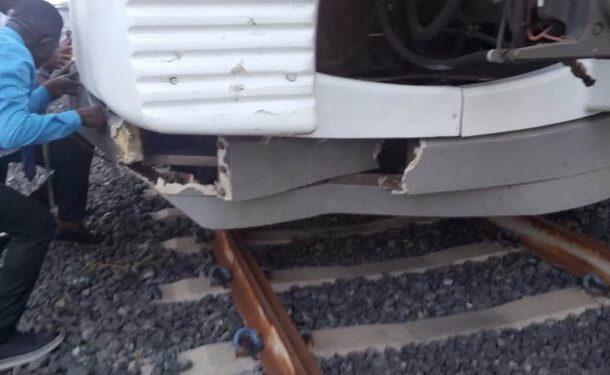
The Ghana Railway Development Authority (GRDA) has warned of increasing safety threats along the Tema–Mpakadan Railway Line after a passenger train struck and killed six goats on the track.
The incident happened on 30 July, when passenger train DMU002 collided with the animals while travelling at about 45 km/h. More than 150 passengers were on board at the time, according to GRDA Chief Executive Officer Frederick Appoh.
Mr Appoh said the collision highlighted continuing problems involving encroachment on the railway corridor, vandalism and deliberate interference with train operations.
He urged members of the public to follow railway safety regulations, warning that trains are unable to stop suddenly or change direction to avoid obstacles.
“A train cannot simply swerve or stop instantly,” he stated.
Mr Appoh explained that the weight and speed of trains meant drivers could not respond immediately when people, animals or objects entered the track area.
The GRDA has also recorded several incidents involving people entering restricted sections of the railway. In one case, an individual remained seated on the track despite repeated warnings from the horn of an approaching train.
Railway staff had to remove the person physically to prevent what the authority described as a possible tragedy.
The GRDA chief executive said the railway had faced deliberate attacks and obstruction in addition to unauthorised access. More than six incidents involving stones being thrown at trains have been documented, along with 11 cases in which stones were intentionally placed on the tracks.
He warned that such actions could create major operational dangers, including the possibility of derailment. The risks are expected to increase when heavier freight services begin operating on the line.
Passenger trains currently using the route generate about 750 kilowatts of power. Freight locomotives expected to enter revenue service will produce approximately 2.25 megawatts, or 3,000 horsepower, and will haul substantially heavier loads.
“Their mass, momentum, and braking distance mean they cannot stop suddenly for a person, animal, or vehicle on the track,” he said.
Mr Appoh also said the authority was struggling to secure some parts of the railway corridor. Newly installed fences have been deliberately vandalised, while other sections are being targeted at night.
Fencing work is continuing in critical areas, but the GRDA said a lack of complete physical protection remained a concern.
Security personnel have been deployed between stations to warn people away from restricted areas and protect the operational corridor.
DMU002 is expected to undergo repairs following its collision with the goats. The authority is also continuing work to strengthen security and secure funding to fence more vulnerable sections of the railway line.
However, Mr Appoh said infrastructure and security staff alone would not solve the problem without greater public cooperation.
“We can engineer a safer railway, but we cannot engineer away indiscipline,” he said.
He called on the public to keep people, vehicles and livestock away from railway tracks and to obey all safety warnings issued by railway officials.





Popular News
No trending posts found.