
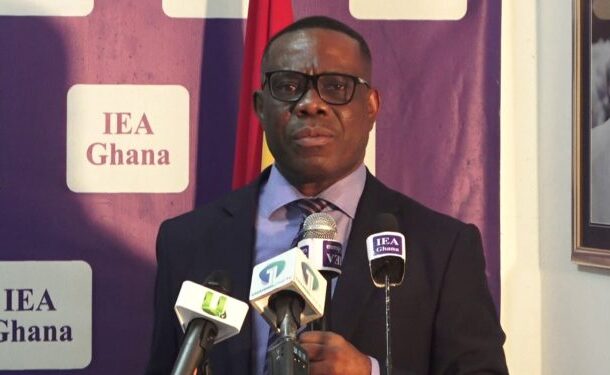
The Institute of Economic Affairs (IEA) has called on the government to abolish tax incentives and review royalty rates in Ghana’s mining sector to ensure the nation gains fair value from its vast natural resources.
According to the policy think tank, the country’s current fiscal and legal frameworks governing the extractive industry are outdated and overly favorable to multinational mining firms, limiting Ghana’s share of the wealth generated from its mineral endowment.
Presenting findings at the IEA’s seminar on “Reviewing Ghana’s Natural Resource Management Framework,” Senior Research Fellow Dr. Eric Oduro Osae said the Minerals and Mining Act, 2006 (Act 703) must be urgently reformed to reflect modern realities and Ghana’s improved technical and regulatory capacity.
Despite more than a century of mining activity, Dr. Oduro Osae noted that Ghana continues to record low fiscal returns compared to the scale of resource extraction. He attributed this to a mix of tax holidays, royalty caps, and stability agreements that have tilted the benefit structure in favor of foreign companies.
IEA data show that in 2024, Ghana’s total mineral revenues reached US$7.1 billion, yet only GH¢17.68 billion was collected in taxes, royalties, and dividends — a figure the Institute described as far below potential earnings due to extensive fiscal concessions and capital flight.
Dr. Oduro Osae stressed that many of these incentives were introduced decades ago, when local expertise in the mining sector was limited. However, those justifications no longer hold true.
“If we quantify all the incentives, it becomes clear that we are giving away too much to the mining sector,” he said.
To correct the imbalance, he proposed a comprehensive overhaul of Ghana’s extractive sector fiscal regime — including:
- Eliminating tax waivers for mining firms.
- Reviewing and possibly removing the 5% royalty cap to reflect true resource value.
- Enhancing local ownership and participation in mining operations.
- Anchoring dispute resolution in Ghanaian courts instead of international arbitration.
“If you match what we give to the mining firms against what we get, there’s a huge gap,” Dr. Oduro Osae said. “We must review ownership structures, abolish tax incentives, and revise royalty rates. At the same time, we should improve transparency and accountability in how mining revenues are managed.”
Also addressing the seminar, former Chief Justice Sophia Akuffo supported calls for a national conference on natural resources to develop a unified strategy for maximizing national benefits.
“Natural resources remain the backbone of our economy, yet their benefits are still skewed,” she said. “This will not change unless we overhaul outdated legal frameworks, curb excessive fiscal incentives, and strengthen local participation.”
The IEA emphasized that such reforms are essential to ensure that Ghana’s natural wealth translates into sustainable development and shared prosperity for its citizens.
Comments