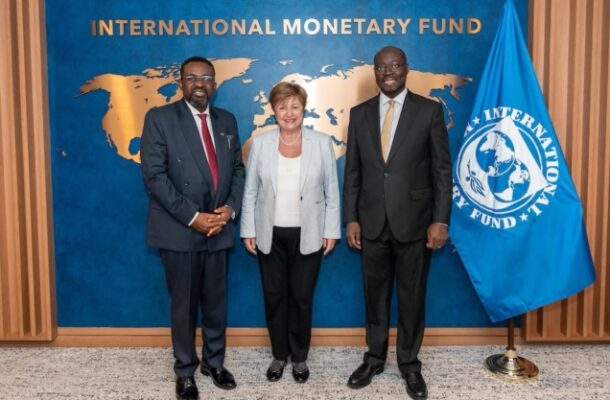
The International Monetary Fund (IMF) has proposed a three-month extension of Ghana’s Extended Credit Facility (ECF) programme to allow more time for the reforms required to complete the sixth and final review.
According to the IMF, the extension is intended to support the implementation of key policy measures underpinning the final programme assessment. The proposal was contained in the IMF Staff Report released after the Fund’s Executive Board approved Ghana’s fifth programme review.
If approved, the extension would move the end date of Ghana’s ECF arrangement from May 2026 to August 2026. The IMF explained that extending the programme through August 16, 2026, would provide sufficient time to reach agreement on policies for the sixth review and to prepare and circulate the necessary Board documentation.
In addition to the extension, the IMF is proposing adjustments to Ghana’s programme framework. These include revisions to Indicative Targets (ITs) and the Monetary Policy Consultation Clause (MPCC).
The Fund noted that the primary balance and non-oil revenue indicative targets for end-March 2026 will be revised to reflect current macroeconomic conditions, while maintaining the overall fiscal effort relative to gross domestic product. Similarly, the MPCC bands for December 2025 and March 2026 are expected to be adjusted downward to better reflect recent macroeconomic developments and projected disinflation trends.
Ghana’s 36-month ECF programme was approved in May 2023, providing access equivalent to 303.8 per cent of the country’s quota—about SDR 2.24 billion, or roughly three billion US dollars. To date, Ghana has received approximately 2.8 billion dollars following the successful completion of the fifth review.
The IMF assessed programme implementation as broadly satisfactory, noting that all end-June 2025 performance criteria and indicative targets were met. It also disclosed that three prior actions were completed ahead of the fifth review: the audit of 2024 payables, the clean-up of taxpayer registry and ledger data, and the submission of the 2026 budget to Parliament in line with programme objectives.
The Fund further reported progress on structural benchmarks that were previously missed during the fourth review. In particular, the strategy for state-owned banks—initially due in April 2024—was implemented in September 2025.
Additionally, the IMF commended Ghanaian authorities for progress in operationalising indicative targets, which have been rephased into three stages. The first phase addresses key elements of earlier missed benchmarks and has been reset as a new end-March 2026 structural benchmark.
Comments