
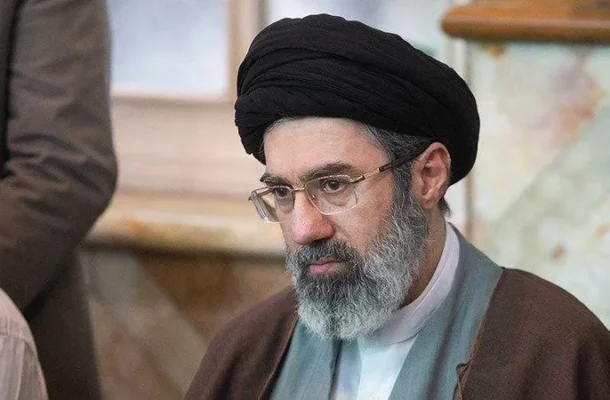
Iran has named Mojtaba Khamenei as its new supreme leader, about a week after the assassination of his father, Ayatollah Ali Khamenei, in joint United States-Israeli strikes that have plunged the entire region into a sprawling war.
The Assembly of Experts named the 56-year-old, who will now be charged with leading the Islamic Republic through the biggest crisis in its 47-year history, as his father’s successor on Sunday.
Key political leaders, the powerful Islamic Revolutionary Guard Corps (IRGC) and the armed forces were quick to pledge their backing to the new leader.
Iran’s President Masoud Pezeshkian said the appointment heralded a “new era of dignity and strength” for the nation.
“This valuable choice is a manifestation of the will of the Islamic nation to consolidate national unity; a unity that, like a solid barrier, has made the Iranian nation resistant to the conspiracies of the enemies,” he said.
Foreign Minister Abbas Araghchi also congratulated the new leader.
“We pledge that, in defence of the rights of the great Iranian nation, the advancement of national interests and security, and the realisation of the lofty goals of the Islamic revolution, we shall not falter for a moment,” he wrote.
Ali Larijani, secretary of the Supreme National Security Council, who has been tasked with steering Iran’s security strategy since the US and Israel launched their all-out offensive on February 28, called for unity around the new supreme leader.
The head of Iran’s powerful Expediency Council, Sadiq Larijani, also joined the chorus of political leaders expressing support for the appointment, saying it reaffirmed the need to continue in the “luminous” path of Iran’s first supreme leader, Ruhollah Khomeini.
Parliament Speaker Mohammad Bagher Ghalibaf welcomed the choice, saying that following the new supreme leader was a “religious and national duty”, while a statement from the defence council said, “We will obey the commander-in-chief until the last drop of our blood.”
Mojtaba Khamenei has never run for office or been subjected to a public vote, but has long been a highly influential figure in the inner circle of the supreme leader, cultivating deep ties to the IRGC.
In recent years, Khamenei had increasingly been touted as a potential replacement for his father, who had been in power since 1989. His selection could be a sign that more hardline factions in Iran’s establishment retain power, and could indicate that the government has little desire to agree to a deal or negotiations in the short term as the war enters its second week.
Rami Khouri, a distinguished public policy fellow at the American University of Beirut, said Khamenei’s appointment signals “continuity”, adding that it remains to be seen whether the new supreme leader will push for negotiations to end the war.
Either way, he said, the appointment was “an act of defiance”. Iran is “telling the Americans and Israelis, ‘You wanted to get rid of our system? Well … this is a more radical person than his father, who was assassinated,’” he said.
Al Jazeera’s Ali Hashem, who has reported extensively on Iranian affairs, described Khamenei as his “father’s gatekeeper”.
“He adopts the positions of his father with respect to the United States, with respect to Israel. So we are expecting a confrontational leader. We’re not expecting any moderation,” he said.
“However, if this war comes to an end and he is still alive, and he is able to continue running the country, there is going to be big potential … to find new routes for Iran,” Hashem said.
The selection of Khamenei’s son is certain to enrage US President Donald Trump, who had previously rejected him as a candidate. The Times of Israel on Monday reported that Trump refused to comment on the Iranian appointment during an interview, only saying: “We’ll see what happens.”
The Israeli military has already threatened to kill any replacement for Khamenei, while Trump said the war may only end once Iran’s military and leaders have been wiped out.
“He’s going to have to get approval from us,” Trump told ABC News on Sunday, of any new supreme leader. “If he doesn’t get approval from us, he’s not going to last long,” Trump said.
US Senator Lindsey Graham, a staunch supporter of Israel, said the new supreme leader was “not the change we’re looking for”. “I believe it’s just a matter of time before he meets the same fate as that of his father,” the Republican lawmaker from South Carolina said on X.
By contrast, Russian President Vladimir Putin pledged “unwavering” support for Mojtaba Khamenei’s appointment and China said it opposed any targeting of the new Supreme Leader.
Supreme leader not decided by ‘Epstein’s gang’
The 88-member Assembly of Experts said on Sunday that it “did not hesitate for a minute” in choosing a new supreme leader, despite “the brutal aggression of the criminal America and the evil Zionist regime”.
Heidari Alekasir, a member of the Assembly of Experts, the clerical body that was tasked with choosing the supreme leader, said the candidate had been picked based on the late Khamenei’s advice that Iran’s top leader should “be hated by the enemy” instead of being praised by it.
“Even the Great Satan [US] has mentioned his name,” the senior scholar said in reference to Trump’s earlier statement that Mojtaba Khamenei would be an “unacceptable” choice for him to lead Iran.
Iranian officials had rejected Trump’s push to be involved in the selection of the next leader, insisting that only Iranians can decide the future of their country.
On Friday, Ghalibaf, the parliament speaker, appeared to ridicule the US president’s demands.
“The fate of dear Iran, which is more precious than life, will be determined solely by the proud Iranian nation, not by [Jeffrey] Epstein’s gang,” he wrote on X, referring to the late sex offender who had ties to rich and powerful figures in the US.
Dark skies
Ali Khamenei, who led Iran for 37 years, succeeding Ayatollah Ruhollah Khomeini, who had led the 1979 Islamic revolution, was killed in a US-Israeli strike on Tehran at the outset of the war, which has now unleashed chaos in many countries across the region.
Besides killing Ali Khamenei and several top officials, the US and Israel have been striking Iranian ships and military installations. Iranian officials have also reported many attacks by the US and Israel on civilian targets, including schools and hospitals, across the country.
Iran has retaliated by attacking Israel and US assets in the region. It has also been accused of launching missiles and drones at civilian targets in the Gulf region, including energy installations, hotels and airports.
As the Shia scholars selected the new supreme leader, a dark haze hung over Tehran after Israel struck five oil facilities in and around the capital overnight, setting them ablaze and filling the skies with acrid smoke.
Meanwhile, the IRGC has said it has enough supplies to continue its drone and missile attacks across the region for up to six months.
IRGC spokesman Ali Mohammad Naini said Iran had so far used only first- and second-generation missiles, but it would use “advanced and less-used long-range missiles” in the coming days.
Meanwhile, Trump again refused to rule out sending US ground troops into Iran, but continued to insist that the war was all but won, despite the ongoing Iranian missile and drone strikes.
Analysts warn there is no clear path to ending the conflict, which US and Israeli officials say could last a month or longer.
Al Jazeera
Comments