Janet Nabla questions Franklin Cudjoe’s neutrality over SALL comments and free speech debate
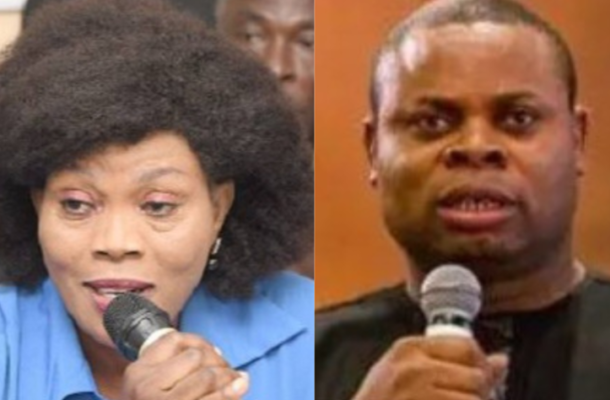
Chairperson of the People’s National Party (PNP), Janet Nabla, has launched a strong criticism against Franklin Cudjoe, accusing the IMANI Africa founder of abandoning neutrality and unfairly targeting former Vice President Mahamudu Bawumia over the long-standing Santrokofi, Akpafu, Lolobi and Likpe (SALL) parliamentary representation controversy.
In a sharply worded statement, the PNP leader argued that political differences should never prevent citizens and civil society actors from defending democratic rights and freedom of expression, especially at a time when concerns are being raised about alleged intimidation, harassment and arrests of opposition voices under the current administration.
According to Janet Nabla, democracy is endangered when individuals are punished or intimidated for expressing dissenting opinions, stressing that the protection of free speech must rise above partisan politics.
She maintained that all Ghanaians, regardless of political affiliation, have a responsibility to speak against actions perceived to undermine democratic freedoms.
The PNP Chairperson further accused Franklin Cudjoe of increasingly aligning himself with one political tradition, claiming that his recent public commentary reflects partisan bias rather than the neutrality expected of a civil society advocate.
She argued that organisations such as IMANI Africa are expected to hold all governments accountable and not selectively criticize political opponents while remaining silent on actions of governments they are perceived to support.
Janet Nabla expressed concern that instead of condemning what she described as attacks on opposition voices, Franklin Cudjoe chose to criticize Dr. Bawumia by linking him to the unresolved SALL issue.
She insisted that publicly available facts do not support claims that Dr. Bawumia was personally responsible for the inability of residents in the SALL area to elect a parliamentary representative during the 2020 general elections.
Providing background to the controversy, she recalled that on March 23, 2024, Franklin Cudjoe reportedly blamed the Attorney-General for the disenfranchisement of SALL residents.
However, according to her, the Attorney-General later clarified publicly that matters relating to constituency creation and elections fall exclusively under the mandate of the Electoral Commission of Ghana under Article 88 of the 1992 Constitution.
She noted that following the clarification, Franklin Cudjoe subsequently redirected blame to the Electoral Commission.
However, she said the Electoral Commission also rejected allegations that it deliberately disenfranchised the people of SALL.
According to the explanation cited by Janet Nabla, the Legislative Instrument establishing the Guan District matured on November 9, 2020 — the same day Parliament went on recess.
The Electoral Commission explained that the law required a Constitutional Instrument to remain before Parliament for 21 sitting days before a new constituency could legally be created, making it impossible to complete the process ahead of the 2020 elections.
Janet Nabla therefore argued that the situation was a constitutional and parliamentary procedural issue rather than a decision taken personally by Dr. Bawumia.
She also referenced the role of Parliament at the time, which was under the leadership of Speaker Alban Bagbin, noting that Parliament had adjourned before the constitutional process could be concluded.
The PNP Chairperson described attempts to link the SALL issue directly to Dr. Bawumia as unfair and intellectually dishonest. She accused Franklin Cudjoe of inconsistency, claiming he had shifted blame from the Attorney-General to the Electoral Commission and now to the opposition leader, while allegedly failing to criticize the current government over concerns of political intimidation.
She further warned that democracy could be weakened if civil society organisations abandon objectivity and factual analysis in favour of partisan political positions.
According to her, any civil society institution that loses neutrality also loses the moral authority to demand accountability from politicians and state institutions.
Janet Nabla consequently called on IMANI Africa to critically assess Franklin Cudjoe’s conduct and determine whether his interventions continue to reflect the organisation’s principles of independence and policy objectivity.
She concluded by stating that if Franklin Cudjoe’s public positions are now driven by partisan loyalty rather than national interest, then IMANI Africa should allow him to openly align himself politically, insisting that Ghana needs independent civil society voices capable of speaking truth to power irrespective of which political party forms government.










Comments (0)