
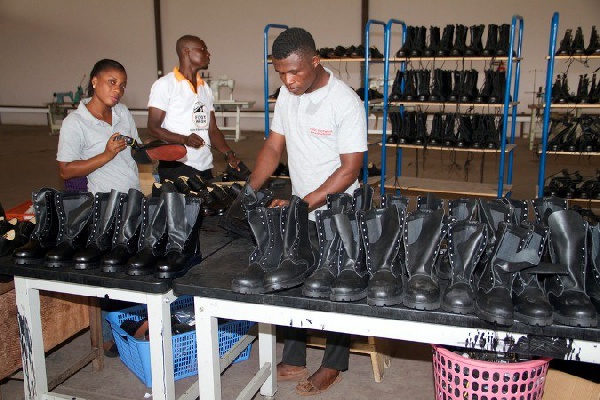
The DIHOC Footwear Division Limited, popularly known as the Kumasi Shoe Factory, is set to install new machinery capable of producing up to 15 million pairs of school sandals annually. However, the company warns that this expansion will not translate into jobs without strong government enforcement of local procurement policies.
The factory is calling on the government—through the Minister of Education, Haruna Iddrisu; Minister of Interior, Muntaka Mohammed Mubarak; and Acting Minister of Defence, Dr. Cassiel Ato Forson—to direct public schools and security agencies to wear locally made footwear. The company argues that without a guaranteed market, initiatives like the 24-hour economy agenda will remain unfulfilled.
Dr. Karl Laryea, Board Chair of DIHOC, said the factory could employ about 1,500 additional workers if sustained demand for locally produced shoes is ensured through enforceable directives.
“Countries like South Africa and India built their local industries by requiring public institutions to buy local products, creating competition among manufacturers, and generating jobs,” Dr. Laryea explained.
The planned expansion includes new assembly lines set to be installed in March, which will scale up production of school sandals for basic schools and boots for security agencies. The factory is capable of producing 10–15 million pairs of school sandals annually, as well as over 700,000 pairs of assorted security boots and shoes each year. Despite this capacity, the factory currently operates at only about eight percent of its potential.
Dr. Laryea emphasised that directives requiring public schools to wear locally made footwear would not only stimulate the shoe industry but also support the 24-hour economy by ensuring consistent demand. He noted that locally produced school sandals could also be supplied at a lower cost, pointing to existing duty exemptions for some raw materials.
He warned that the continued importation of footwear by public institutions undermines local manufacturing and places unnecessary pressure on the cedi.
Dr. Laryea also criticised state institutions for failing to comply with government directives on local procurement. In 2014, then-President John Mahama directed state agencies to source their footwear from the Kumasi Shoe Factory, but compliance was virtually non-existent. Similarly, a directive issued last year by the Minister of Interior to agencies under his ministry has not been enforced.
The agencies involved include the Ghana Police Service, Ghana National Fire Service, Ghana Prisons Service, Ghana Immigration Service, the National Disaster Management Organisation, and the National Service Secretariat.
“I have personally engaged these agencies and written to them twice, yet nobody is buying,” Dr. Laryea said. He explained that agencies have refused to provide the factory with their size specifications—known as size rolls—essential for production. Some have even asked the factory to produce footwear without confirmed sizing, promising to purchase later.
“This approach makes proper planning impossible and allows continued importation,” he said.
Dr. Laryea called for strict enforcement, warning that heads of departments who refuse to comply with government directives must face consequences. He also highlighted the social cost of the current situation, noting that while schools and security services continue to import footwear, some children in deprived districts still attend school barefoot.
Comments