
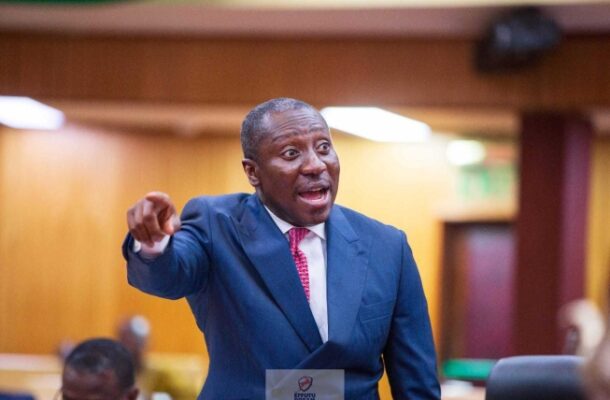
Private legal practitioner Thaddeus Sory has alleged that Minority Leader Alexander Afenyo-Markin played a key role in his client’s decision to petition for the removal of former Chief Justice Gertrude Araba Sackey Torkonoo.
According to Mr. Sory, one of the central arguments in the petition directly referenced the Effutu MP and highlighted actions that, in his view, contributed significantly to the basis of the complaint.
He noted that Mr. Afenyo-Markin set an “unprecedented record” by securing a full Supreme Court panel—chaired by Justice Torkonoo—within two hours to grant orders that no court in a common law jurisdiction would normally approve under such an application.
Mr. Sory argued that the Minority Leader’s conduct raised concerns not only for the former Chief Justice but also for Justice Gabriel Pwamang, who chaired the committee that recommended her removal.
He said Justice Pwamang’s report itself raised questions he had previously highlighted, and the issues became clearer as proceedings progressed.
Mr. Sory also disclosed that several individuals who knew both Mr. Afenyo-Markin and the former Chief Justice privately approached him, asking why he did not realise the two shared close ties.
“People came to me saying, ‘that is his sister,’ because they come from the same area,” he recounted.
He added that he was informed that when Justice Torkonoo’s father died, the Minority Leader hosted visitors who came to show their condolences—information he said came from eyewitnesses.
Mr. Sory stated that if he had appeared at the next scheduled sitting, he would have raised a formal objection against Justice Torkonoo, telling her that the tension surrounding the case was rooted in the fact that “someone close to her—Afenyo-Markin—was the plaintiff.”
He further alleged that new information suggests certain services within the Judicial Service are linked to the Minority Leader and that Mr. Afenyo-Markin benefits financially from providing those services.
According to him, this explains why the Minority Leader is attempting to frame the nomination of Chief Justice Baffoe Bonnie as a national issue.
He insisted that the matter has little to do with the collective stance of the Minority in Parliament:
“The facts show the Minority Leader has a personal interest in the former Chief Justice. That is why he is crying louder than everyone else.”
Mr. Sory also questioned the structure of Parliament’s approval process for judicial appointments.
He argued that the Constitution calls for the “prior approval of Parliament”—not necessarily a vetting process.
He proposed that Parliament conduct comprehensive background checks and examine nominees’ CVs in detail, only resorting to vetting when clarification is required.
In other cases, he said, approval should be by acclamation.
He added that if a judicial appointee underperforms, the appointing authority already has the constitutional power to remove them.
Mr. Sory concluded that the current vetting system places unnecessary pressure on nominees and prolongs a process that could be more efficient and less politicised.
Comments