
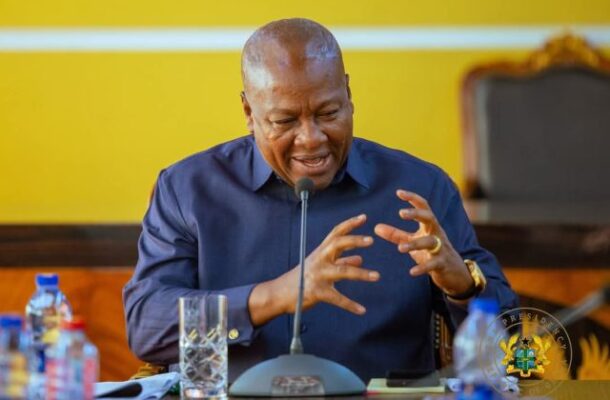
President John Dramani Mahama has proposed that factories operating under Ghana’s 24-Hour Economy programme be allowed to import capital machinery and equipment without paying duties and taxes to accelerate industrial growth.
He made the announcement on February 24, 2026, during a ceremony in Shama in the Western Region, where he performed the sod-cutting for a new float glass manufacturing plant, commissioned a sanitary ware factory, and inaugurated phase five of a ceramic tile production line.
“Factories registered under the 24-Hour Economy programme will be allowed to import machinery and equipment without paying duties and taxes. This will make it easier for them to scale up operations and compete globally,” President Mahama stated.
He explained that the proposal followed concerns raised by private sector operators about the high cost of importing machinery to establish or modernise factories.
“For factories that are established and registered under the 24-Hour Economy Initiative, if they want to expand or bring in new equipment to retool their factories, they should be able to bring that equipment into the country duty- and tax-free,” he added.
According to the President, the incentive is intended to stimulate local manufacturing, reduce Ghana’s reliance on imports, and create sustainable employment opportunities.
President Mahama also revealed that he granted presidential assent to the 24-Hour Economy Authority Bill about two weeks ago, officially making the authority operational.
He noted that business leaders strongly raised concerns about import duties during a recent Presidential Dialogue with the private sector, describing the charges as a major barrier to expansion and fresh investment.
“That is why I can assure investors that the incentives are coming,” he said.
The President emphasised that production remains central to strengthening the country’s economy and currency.
“Production underpins the value of currency, not by speculation, but by production and exports,” he stressed.
Speaking on the float glass manufacturing project, he described it as a strategic initiative to curb imports, noting that Ghana currently imports the bulk of its glass products.
He disclosed that in 2024 alone, Ghana imported more than 65,000 tonnes of glass products valued at nearly $25 million to supply the construction, automobile, and manufacturing sectors.
Once completed and fully operational, the new factory is expected to reduce imports, conserve foreign exchange, generate export revenue, and create more than 2,000 direct jobs, alongside numerous indirect employment opportunities.
President Mahama concluded by stressing that successful industrialisation depends on collaboration between government, investors, and local communities.
“Industrialisation succeeds when government provides stability, investors provide capital, and communities provide partnership,” he said.
Comments