
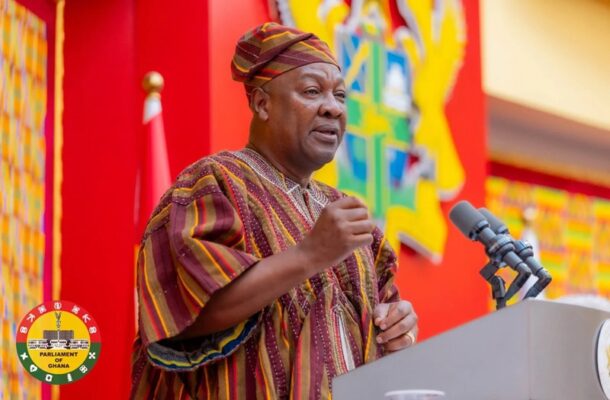
President John Dramani Mahama has placed healthcare financing at the centre of the national recovery strategy, announcing a major policy shift toward domestic funding that signals a long-term move away from donor dependence and externally driven health systems.
Delivering his 2026 State of the Nation Address (SONA) in Parliament on Friday, February 27, the President revealed that total health sector financing has risen sharply to GH₵34.7 billion, up from GH₵23.3 billion in 2023, marking one of the largest increases in public health investment in recent years.
Rather than framing the announcement simply as a budgetary increase, Mahama presented the figures as part of a broader ideological shift toward what he described as health sovereignty — the principle that Ghana must finance and control its own healthcare system through domestic resources rather than external aid and donor dependency.
He disclosed that in 2026, direct government funding will account for about 72% of total national health spending, a significant rise from 56.8% in 2023, underscoring a deliberate policy decision to anchor healthcare delivery in national fiscal capacity.
According to the President, core health allocations alone now stand at GH₵23.3 billion, and when resources from the National Health Insurance Scheme (NHIS) are added, total health financing reaches GH₵34.7 billion.
He described this structure as evidence of a new financing model in which the Ghanaian state, rather than foreign partners, becomes the primary guarantor of healthcare delivery.
Placing the announcement in historical context, Mahama referenced the long-standing structural dependence on donor-funded health programmes, budget support, and externally financed interventions, particularly in primary healthcare, maternal health, and disease control.
Previous administrations, including those under structural adjustment and post-IMF programmes, often relied heavily on development partners to sustain core health services.
Mahama’s SONA framing positions the current policy direction as a strategic break from that model.
The President argued that sustainable healthcare cannot be built on unpredictable external funding flows and conditional aid structures.
Instead, he said, national resilience requires domestic fiscal commitment, stable public financing, and institutional investment that guarantees continuity of care regardless of global economic shocks or donor policy shifts.
Beyond financing, Mahama linked the funding increase to his administration’s broader development agenda, which seeks to integrate healthcare into national productivity, economic resilience, and human capital development.
He presented healthcare not only as a social service, but as a strategic investment in workforce capacity, national stability, and long-term economic growth.
The announcement comes at a time when Ghana’s health sector has faced persistent challenges, including infrastructure gaps, health worker migration, medical supply constraints, and pressure on the NHIS system.
By increasing domestic funding and government contribution ratios, the administration is signaling an attempt to stabilise the sector structurally rather than rely on short-term interventions.
In political terms, the declaration also reinforces Mahama’s SONA 2026 narrative of rebuilding state capacity after years of fiscal strain and economic instability.
The health funding figures were presented as part of a wider recovery programme that includes domestic resource mobilisation, institutional strengthening, and sovereign economic management.
Comments