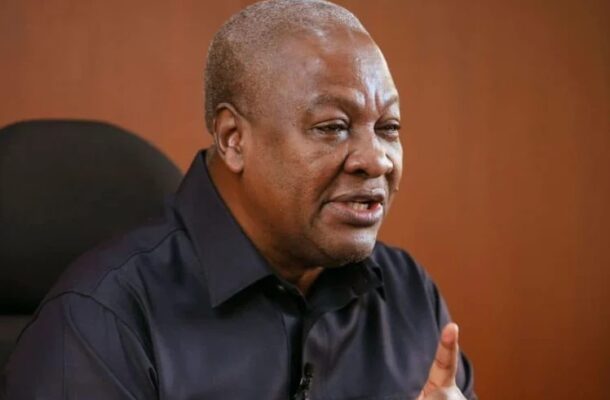
President John Dramani Mahama is facing sharp criticism from the opposition New Patriotic Party (NPP) after warning that escalating tensions in the Middle East could negatively impact the economy.
The criticism stems from what opposition figures describe as a dramatic shift in Mahama’s position on the role of global crises in shaping Ghana’s economic fortunes.
The controversy erupted following remarks the President made during bilateral talks with the Tanzanian President, Samia Suluhu Hassan in Arusha on March 3, 2026, on the sidelines of the legal year ceremony of the African Court on Human and Peoples’ Rights.
Addressing the growing tensions involving the United States, Israel and Iran, Mahama cautioned that an escalation of hostilities across the Middle East—particularly if it spreads to the Gulf states—could disrupt global oil supplies and trigger a ripple effect on African economies, including Ghana.
According to the President, the reliance on imported crude oil and refined petroleum products leaves the country exposed to global energy price fluctuations.
He warned that a sustained rise in international oil prices would inevitably lead to higher fuel costs domestically, with consequences for transportation fares, food prices and the general cost of doing business.
Mahama further highlighted the strategic importance of the Strait of Hormuz, one of the world’s most critical maritime oil transit routes.
A significant share of global oil shipments passes through the narrow channel each day, and any disruption to shipping activities there could cause sharp spikes in global crude prices.
The President noted that instability in the region could undermine efforts to stabilise Ghana’s economy following recent debt restructuring measures.
He disclosed that his administration had directed the Ministers responsible for Finance and Energy to closely monitor developments in the Middle East and prepare contingency measures to cushion the economy from potential shocks.
Economic Recovery And Policy Measures
John Mahama made the remarks at a time when the government says the economy is gradually recovering from the severe financial crisis that peaked between 2022 and 2023.
According to data cited by the Presidency and the Bank of Ghana, inflation has declined sharply from about 54 percent in 2022 to roughly 3.3 percent by February 2026.
Opposition Raises Double Standards Accusations
Despite these assurances, opposition members say the President’s warnings about external shocks contradict the position he took while leading the National Democratic Congress (NDC) in opposition.
Between 2017 and 2024, when the NDC was out of power, Mahama repeatedly dismissed the explanation offered by the administration of former President Nana Addo Dankwa Akufo-Addo that global events were responsible for Ghana’s economic downturn.
During the height of the economic crisis, the Akufo-Addo government frequently cited the combined impact of the COVID-19 pandemic and the Russia–Ukraine War as major contributors to rising inflation, currency depreciation and fiscal pressures.
However, Mahama and other NDC officials rejected that argument, insisting that Ghana’s economic problems were largely self-inflicted.
He famously described the government’s claim that global shocks were to blame as a “bloody lie,” arguing that the country’s economic decline had begun long before Russia’s invasion of Ukraine in 2022.
Renewed Political Tensions
The opposition now argues that Mahama’s current warnings about global instability affecting Ghana represent a reversal of his earlier position.
Some NPP communicators say the President is now employing the same argument he previously criticized when the NDC was in opposition.
They insist that the government should focus on addressing domestic economic challenges rather than attributing potential price increases to conflicts occurring thousands of kilometres away.
Among those leading the criticism is Richard Ahiagbah, Director of Communications for the NPP, who has called on the government to provide clear policy responses instead of issuing warnings about possible economic shocks.
According to him, if the NDC government anticipates higher global oil prices, it must explain whether it intends to absorb the additional costs or pass them on to consumers through increased fuel prices.
Other opposition figures have also pointed to local economic challenges—such as delayed payments to cocoa farmers and rising electricity tariffs—as examples of domestic issues they believe cannot be blamed on international developments.
Wider Diplomatic Developments
Mahama’s remarks in Tanzania were also delivered within the context of broader diplomatic engagements. During the meeting with President Suluhu Hassan, he announced Ghana’s intention to present a resolution at the United Nations General Assembly on March 25 seeking formal recognition of the transatlantic slave trade as a crime against humanity.
Meanwhile, rising tensions in the Middle East have already had diplomatic consequences for Ghana. Following reported military strikes on Iranian targets by the United States and Israel on February 28, 2026, Ghana evacuated its embassy staff from Iran.
The Minister for Foreign Affairs, Samuel Okudzeto Ablakwa, confirmed that all Ghanaian diplomats stationed in Tehran were safely evacuated and that the embassy had been closed indefinitely as a precautionary measure.
Debate Over Global Versus Domestic Factors
The latest political exchanges highlight a broader debate that has persisted in Ghana’s political discourse for years: the extent to which global crises should be blamed for domestic economic challenges.
While the Mahama administration maintains that external shocks such as geopolitical conflicts can have real consequences for economies that depend heavily on imported energy, opposition figures insist that government policy choices remain the most important determinant of economic performance.
However, as tensions in the Middle East continue to evolve, the dispute between the governing NDC and the opposition NPP over how global developments affect the economy is likely to remain a major point of political contention in the months ahead.
Comments