
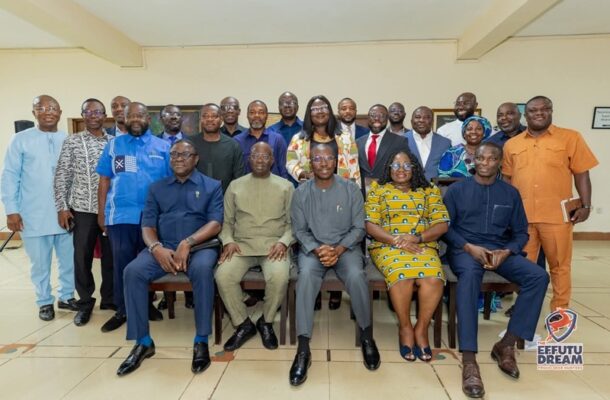
A delegation from the Minority Caucus in Parliament, led by Minority Leader Alexander Afenyo-Markin, has raised serious concerns about the deteriorating conditions within the industrial sector following a detailed engagement with the Association of Ghana Industries (AGI).
The meeting, held on April 1, 2026, brought together key opposition lawmakers and industry leaders, culminating in what the Minority describes as an “evidence-grounded account” of policy failures undermining local production.
The engagement forms part of ongoing parliamentary oversight efforts, particularly against the backdrop of longstanding economic challenges—currency depreciation, high inflation, energy sector debts, and industrial financing constraints—that have persisted across successive governments.
While the industrial sector has historically shown resilience, the Minority argues that recent policy decisions have compounded existing vulnerabilities, pushing many manufacturers toward shutting down operations in favor of importation.
The Minority delegation included senior MPs such as Patricia Appiagyei, Jerry Ahmed Shaib, Kwaku Agyeman Kwarteng, and Michael Okyere Baafi, among others.
They were received by AGI leadership, including President Kofi Nsiah-Poku, CEO Seth Twum-Akwaboah, and past president Humphrey Kwesi Ayim-Darkeh.
Industrial Sector “Under Siege”
According to the Minority, industry players painted a troubling picture of an environment that is increasingly hostile to local manufacturing.
They cited rising operational costs, unstable policy frameworks, and weak enforcement regimes as key drivers of decline. One striking observation from the meeting was that it has become more economically viable for businesses to import goods rather than produce locally.
The caucus highlighted examples where between 70% and 80% of beverages consumed in Ghana are imported, while local producers struggle under high tax burdens and competition from smuggled goods entering the market duty-free.
Companies sourcing local raw materials and employing large workforces are reportedly being edged out by underpriced imports, creating a structural imbalance within the economy.
Energy Costs And Policy Burdens
Energy pricing emerged as a dominant concern. Industrialists attributed high electricity costs not to market forces, but to accumulated levies embedded in tariffs over time. With tariffs pegged to exchange rates that have significantly worsened—from around GHS 16 to much higher levels—the cost of production has surged beyond sustainable limits.
Many companies, the Minority noted, are now resorting to solar energy—not as a green initiative but as a survival strategy to escape high tariffs from the Electricity Company of Ghana.
Concerns were also raised about the role of the Public Utilities Regulatory Commission (PURC), particularly regarding tariff calculations, exchange rate applications, and inconsistencies in smart meter systems.
Controversy Over AI Duty Systems And Tax Stamps
The introduction of an AI-driven excise duty assessment system at Ghana’s ports has also sparked concern. According to industry stakeholders, the system is generating inflated and often irrational duty values, with no established appeal mechanism currently in place.
Compounding this issue is a lack of transparency surrounding changes to the tax stamp system managed by the Ghana Revenue Authority (GRA).
The AGI told the Minority that a new supplier has been introduced without consultation or disclosure, raising fears about operational disruptions and increased compliance costs.
VAT Reforms And Compliance Challenges
The removal of the flat rate VAT regime has further complicated tax compliance for manufacturers, particularly those operating within or alongside the informal sector. Industrialists argued that the new system is difficult to implement and lacks supportive mechanisms such as exemptions or withholding structures.
Comparisons were drawn with countries like Kenya, where VAT relief systems are applied more flexibly. While the GRA continues to report strong revenue performance, the Minority cautioned that aggressive enforcement without structural reform risks overburdening already compliant businesses rather than expanding the tax base.
Financing Constraints and Lack Of Patient Capital
Access to long-term financing remains a critical barrier. The Minority noted that most industrial loans in Ghana have a maximum tenure of just two years—far below what is required for manufacturing and agro-processing investments.
Although the Development Bank of Ghana (DBG) was established to address this gap, concerns persist that its funds are being routed through commercial banks at high interest rates, limiting accessibility for SMEs. The caucus is advocating for expanded capitalisation of DBG and the use of oil revenues to support long-term industrial financing.
1D1F Abandonment And Skills Gap
The fate of the One District One Factory (1D1F) initiative also featured prominently in discussions. Originally introduced under the previous administration to decentralise industrial development, the programme reportedly left behind about 70 uncompleted factories.
The Minority criticised the current government for abandoning the initiative without clarity on commitments made to participating companies.
In its place, the government has introduced the 24-hour economy policy, but the Minority says its practical implications for industry remain unclear.
Additionally, concerns were raised about the education system, which industry leaders say remains overly theoretical. The lack of technical and vocational skills has forced many companies to rely on foreign expertise, exposing long-standing weaknesses in workforce development programmes such as those under the Youth Employment Agency (YEA).
Minority Pledges Parliamentary Action
The Minority Caucus says it will escalate the concerns raised during the engagement through parliamentary mechanisms, including committee inquiries and formal questions to relevant state institutions. It also plans to institutionalise quarterly engagements with the AGI to ensure sustained dialogue between policymakers and industry.
The caucus concluded that the ability to build a productive and self-sustaining economy hinges on whether government policies begin to align with the realities of industry. Without urgent reforms, they warn, the country risks deepening its dependence on imports at the expense of local enterprise and job creation.
Comments