
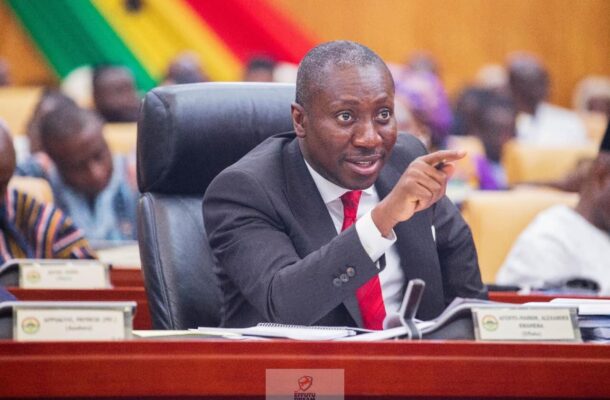
The Minority in Parliament has strongly criticised the administration of President John Dramani Mahama, accusing the government of worsening the economic hardship facing many citizens and failing to uphold the promise of Ghana’s independence.
In a statement released to mark the country’s 69th Independence Anniversary on March 6, 2026, the Minority said the struggles confronting farmers, workers and young people raise serious concerns about the direction of the country under the current administration.
Ghana commemorated 69 years of independence from British colonial rule, a milestone first achieved on March 6, 1957 under the leadership of Kwame Nkrumah.
The Minority acknowledged the significance of the anniversary, paying tribute to the sacrifices of farmers, workers, chiefs, market women, youth and freedom fighters who contributed to Ghana’s liberation and the establishment of the Republic.
According to the opposition lawmakers, the occasion should serve not only as a moment of national pride but also as a time for critical reflection on whether the country is fulfilling the ideals envisioned by its founding generation.
In their view, the spirit of independence demands a nation built on justice, economic opportunity and shared prosperity. However, the Minority argued that the current reality for many Ghanaians reflects deep economic and governance challenges that must be urgently addressed.
Dispute Over Public Sector Dismissals
One of the key issues highlighted by the Minority was the termination of public-sector workers following the return of the National Democratic Congress (NDC) to power in January 2025. According to the statement, the dismissals affected thousands of employees across several government institutions and disproportionately impacted young graduates entering the labour market.
The Minority cited findings from a review committee reportedly established by the Chief of Staff to investigate the dismissals. The committee examined 2,080 employment cases across 36 public institutions, including the Electricity Company of Ghana, Ghana Highway Authority, Ghana Ports and Harbours Authority, National Health Insurance Authority, Metro Mass Transit, Social Security and National Insurance Trust and the University of Energy and Natural Resources.
According to the review, 1,539 of the appointments were found to have been properly made, while 541 were recommended for revocation due to procedural issues.
The Minority argued that the findings vindicate their earlier criticism that the dismissals were arbitrary and unjustified.
They therefore demanded the immediate reinstatement of all workers cleared by the committee, the payment of withheld salaries and compensation for those affected by the dismissals.
Farmers Facing Severe Challenges
The opposition also expressed concern about the worsening conditions facing farmers across the country, particularly in the rice, cashew and vegetable sectors.
Rice farmers, especially in northern Ghana, were said to be struggling with large volumes of unsold produce following the 2024 harvest season.
According to the Minority, millers have reduced operations due to competition from imported rice and the absence of effective state procurement systems, leaving many farmers burdened with debt from agricultural inputs.
Cashew farmers were also cited as facing serious financial difficulties after the government reportedly reduced the minimum producer price for raw cashew nuts from GH₵15 per kilogram to GH₵12 in December 2025.
The Minority described the move as a significant blow to farmers’ incomes and warned that the situation has allowed unlicensed middlemen to purchase cashew below the regulated price.
In addition, they pointed to large post-harvest losses affecting crops such as yam and pepper, particularly in parts of the Upper East Region where poor storage infrastructure and inadequate processing facilities have led to tonnes of produce spoiling before reaching the market.
The Minority called on the government to introduce emergency support measures for farmers, restore a fair pricing regime for cash crops and invest in storage facilities, rural roads and agro-processing infrastructure.
Cocoa Sector Under Pressure
The statement also focused on the challenges facing cocoa farmers, whose role in Ghana’s economic development dates back to the pre-independence era. Cocoa exports historically financed major infrastructure and development projects during the early years of the country’s independence.
However, the Minority accused the government of undermining cocoa farmers through what they described as a significant reduction in the farm-gate price of cocoa.
According to the opposition lawmakers, the reduction—reportedly exceeding GH₵1,000 per bag—has increased the financial burden on farmers and left many struggling to support their families.
They argued that the situation contradicts the historic contributions of cocoa farmers to Ghana’s economic growth and called for policies that protect the livelihoods of producers.
Illegal Mining Crisis
Illegal mining, widely known as galamsey, was another major issue raised by the Minority. They warned that the continued destruction of forests, pollution of rivers and degradation of farmland represent a national environmental emergency.
The opposition criticised what it described as the government’s inadequate response to the problem, arguing that stronger enforcement measures are needed against both illegal miners and the financiers behind the operations.
The Minority also referenced reports that approximately 1,070 Chanfang excavators intended for mining operations had been intercepted at the Tema Port. While welcoming the seizure, they called for full disclosure of those responsible for importing the equipment and demanded that the machines be destroyed to prevent their use in illegal mining activities.
Economic Transformation Still Unfulfilled
Reflecting on the economic trajectory since independence, the Minority argued that the country remains overly dependent on exporting raw commodities while importing finished goods. This, they said, continues to limit job creation and expose the economy to external shocks.
They called for renewed efforts to accelerate industrialisation, modernise agriculture and invest in education and digital innovation to equip young Ghanaians with the skills needed for the modern global economy.
Security And Diaspora Concerns
The Minority also raised concerns about recent attacks on Ghanaian fishing vessels within the country’s territorial waters. While commending the Ghana Armed Forces for responding to the incidents, they urged the government to strengthen maritime security and provide Parliament with a full briefing on the attacks.
In addition, the opposition expressed solidarity with Ghanaians living and working in the Gulf region amid ongoing conflicts in parts of the Middle East. They called on the government to ensure that diplomatic missions remain actively engaged in providing assistance and protection to Ghanaian citizens abroad.
Comments