
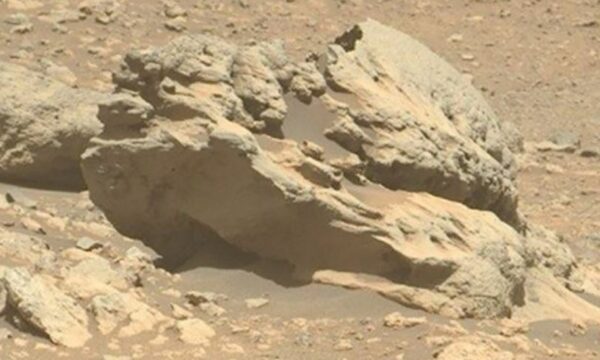
NASA discovers a rock on Mars that appears to have originated beyond the Red Planet. The mysterious iron-nickel formation, named Phippsaksla, could reshape scientific understanding of Mars’ ancient history and the wider Solar System.
A Martian Mystery Takes Shape
NASA’s long-running Mars mission has taken another intriguing turn, as the Perseverance rover has identified a rock that may not belong on the planet at all. The discovery — titled NASA discovers a rock on Mars that doesn’t belong on that planet — has drawn global attention, with scientists suggesting the object may be an ancient meteorite that travelled millions of kilometres before landing on Martian soil. The keyword NASA discovers a rock on Mars that doesn’t belong on that planet reflects both the surprise and scientific excitement surrounding the find.
More than five years after Perseverance began its mission, the rover continues to examine the Martian landscape with unwavering precision. Its latest observation, however, stands out as one of the most unusual geological clues uncovered in the Jezero Crater.
Unusual Find in Jezero Crater
Phippsaksla: The Rock That Defies Martian Expectations
The newly identified stone, discovered in the Vernodden region of Jezero Crater, spans roughly 80 centimetres and has been officially named Phippsaksla. NASA has released two images of the formation — one taken from a distance and another captured at close range — both highlighting its distinct structure.
What immediately caught the scientific team’s attention was the rock’s composition. Early assessments suggest it is unusually rich in iron and nickel. This is significant because iron-nickel formations are seldom found among typical Martian rocks. Instead, they are characteristic of meteorites formed from the dense metallic cores of ancient asteroids during the turbulent early period of the Solar System.
A Shape That Tells a Story
Why Scientists Suspect an Extraterrestrial Origin
The rock’s carved, towering appearance set it apart from its surroundings. While the region contains a variety of sediments shaped by ancient water activity, Phippsaksla protrudes unusually from the surface, prompting further examination.
NASA researchers believe such distinct features hint at atmospheric entry and impact processes rather than natural Martian erosion. Although further analysis is required to confirm whether it is indeed a meteorite, early indications support the theory that Phippsaksla may have originated far beyond Mars.
If confirmed, the discovery will mark another milestone for Perseverance and expand scientific understanding of the materials that have shaped Mars throughout its long geological history.
Perseverance’s Ongoing Achievements
Since landing on the Red Planet in February 2021, the rover has carried out extensive research across ancient lake beds, sedimentary plains, and crater systems. Its mission has revealed unusual rock formations, diverse mineral deposits, and signs that microbial life may once have existed on Mars.
The finding under the headline NASA discovers a rock on Mars that doesn’t belong on that planet adds to an impressive catalogue of scientific achievements. It also reinforces Perseverance’s crucial role in uncovering Mars’ complex past — one rock at a time.
A Discovery That May Rewrite Martian History
Phippsaksla and the Future of Martian Exploration
While scientists await further testing to confirm the rock’s true origin, Phippsaksla already stands as a symbol of the unexpected discoveries that continue to emerge from Mars. As Perseverance continues its mission, the story behind NASA discovers a rock on Mars that doesn’t belong on that planet is likely to reveal even more about the Red Planet’s ancient interactions with cosmic objects — and possibly, about the very formation of our Solar System.
Comments