
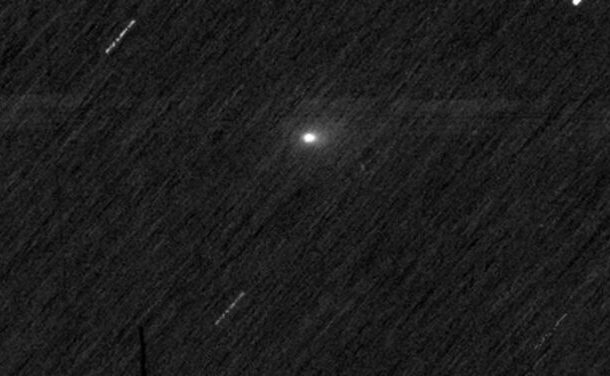
NASA releases photos of Comet Atlas, unveiling new details about the interstellar object 3I/ATLAS. This BBC-style report explores the comet’s journey, scientific significance, and upcoming close pass by Earth.
A Cosmic Revelation Years in the Making
For the third time in history, an interstellar object has entered our solar system — and this week, NASA releases photos of Comet Atlas, offering humanity a rare window into a visitor from deep space. The newly published images, delayed by the recent US government shutdown, shed light on one of the most mysterious bodies ever detected travelling between the stars. With the comet now moving through the inner solar system, scientists say the extraordinary event presents an unparalleled opportunity to study material originating beyond our cosmic neighbourhood.
NASA Releases Photos of Comet Atlas
First Images Reveal a Bright, Mysterious Object
The latest photographs from several NASA spacecraft reveal 3I/ATLAS as a radiant point of light, cloaked in a delicate halo of cosmic gas and dust. In some frames, a faint, elongated tail stretches behind it — the unmistakable signature of a comet interacting with solar radiation.
Although the images may appear visually simple, researchers emphasise their scientific value. Every flicker, every haze of dust, and every shift in the tail offers clues to the comet’s composition, temperature, and behaviour as it sweeps past the Sun.
A Delayed Release After Government Shutdown
NASA confirmed that the publication of the images was postponed due to the recent US government shutdown, which halted operations across federal agencies. With normal activities now resumed, mission teams have been able to process and share the long-awaited data gathered during the comet’s passage through the inner solar system.
A Rare Interstellar Arrival
Only the Third Confirmed Visitor Beyond Our Solar System
Discovered in July, 3I/ATLAS immediately sparked global excitement among astronomers. It is only the third confirmed interstellar comet ever observed, following the breakthrough discoveries of 1I/‘Oumuamua in 2017 and comet 2I/Borisov in 2019.
Its arrival has prompted both rigorous scientific study and widespread speculation. Some online theories suggested it might be alien technology or an artificial craft. NASA firmly rejected those claims, stating the object is “fully consistent with what is expected of a normal comet.”
What Comes Next for 3I/ATLAS
A Critical Window for Scientific Observation
In the coming weeks, researchers expect to gather detailed data on the comet’s speed, structure and probable origin. 3I/ATLAS made its closest approach to the Sun in late October and is now travelling along a trajectory that will make it re-emerge from behind the Sun in early December.
Because the comet has recently been too close to the Sun to observe from Earth-based telescopes, NASA’s spacecraft images are presently the only available visual data. Ground observatories are preparing to begin tracking it again once it becomes visible.
A Safe Encounter With Earth
Close Pass Expected on 19 December
Although NASA releases photos of Comet Atlas amid increasing public curiosity, the agency reassured the world that the comet poses no threat. On 19 December, 3I/ATLAS will pass Earth at a distance of roughly 170 million miles — far beyond any danger zone.
A Moment of Discovery as Comet Atlas Continues Its Journey
The release of these images marks a major step forward in our understanding of interstellar objects and the history they carry from distant star systems. As scientists prepare for more observations, NASA releases photos of Comet Atlas at a moment when curiosity and scientific opportunity align. In the weeks ahead, 3I/ATLAS will continue its silent voyage — a brief visitor from another world, offering insights that may shape our understanding of the universe for years to come.
Comments