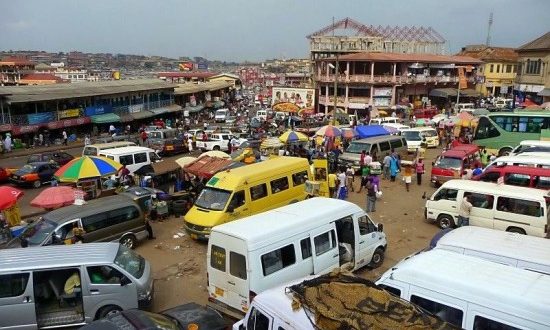
As Ghana grapples with worsening traffic congestion and urban mobility issues, the National Development Planning Commission’s (NDPC) Transport Infrastructure Framework (2018–2047) underscores the critical role of local government in addressing the crisis.
The long-term plan, part of the broader Ghana Infrastructure Plan (GIP), identifies persistent gaps in urban transport infrastructure and calls for stronger decentralised action to improve traffic management, road networks, and public transport systems across the country’s rapidly growing cities.
These concerns were echoed on the Citi Breakfast Show on Wednesday, January 14, where Citi FM and Channel One TV Managing Director Samuel Attah-Mensah argued that Ghana’s transport problems cannot be solved merely by supplying more buses.
He highlighted deep inequalities in vehicle ownership, noting that most low-income residents depend on public transport but lack access to proper roads, bus terminals, and organised trotro stations.
Mr Attah-Mensah stressed that Ghana already has a long-term transport roadmap under the NDPC’s 2018–2047 framework, describing transport infrastructure as a national priority that has suffered from weak implementation, particularly at the local level. Programme host Bernard Avle also called for urban mobility to be placed at the centre of public discourse and urged local government institutions to take greater responsibility for managing transport systems.
Local Government at the Heart of Urban Transport Management
The NDPC framework, in line with Ghana’s decentralisation laws, positions Metropolitan, Municipal, and District Assemblies (MMDAs) as the frontline actors in urban transport planning and implementation.
Supervised by the Ministry of Local Government, Decentralisation and Rural Development (MLGDRD), MMDAs are responsible for local development, including municipal roads, traffic management, spatial planning, and basic urban infrastructure—essential components of effective urban mobility.
This aligns with remarks by the Executive Secretary of the Inter-Ministerial Coordinating Committee (IMCC) on Decentralisation, Dr Gameli Hoedoafia, who stated that transport challenges are primarily district-level responsibilities. While the central government sets policy through the Ministry of Transport, implementation rests with local authorities already empowered by law to act.
Challenges: Financing and Capacity Constraints
Despite these defined roles, the NDPC framework identifies significant barriers limiting local government effectiveness.
Limited internally generated funds (IGF) constrain MMDAs’ ability to finance transport infrastructure, with most assemblies relying heavily on the District Assembly Common Fund (DACF) and donor support—resources often insufficient to meet growing urban demands.
Capacity gaps, particularly in technical planning, project prioritisation, and structuring public–private partnerships, have further slowed transport project delivery. Weak data systems, poor coordination between national and local institutions, and inconsistent enforcement of spatial plans also undermine efficiency.
The scale of investment required compounds these challenges. Ghana’s infrastructure plan estimates tens of billions of dollars will be needed over the next three decades to modernise transport networks, much of which will need to come from innovative financing and private sector participation rather than traditional public funding.
The Way Forward: Strengthening Decentralised Action
The NDPC framework and policy stakeholders propose a multi-pronged approach to address these challenges:
- Capacity Building: Strengthen technical support to MMDAs in urban transport planning, project management, and financing.
- Integrated Local Planning: Mainstream transport and spatial planning into medium-term development plans to reduce congestion and manage urban growth.
- Fiscal Decentralisation: Enhance IGF mobilisation and fiscal autonomy to reduce overreliance on central government transfers.
- Public–Private Partnerships: Support local authorities in leveraging private finance for urban mobility solutions such as mass transit systems and traffic management infrastructure.
The NDPC framework emphasizes that while national policy direction and financing remain important, the transformation of Ghana’s urban transport system ultimately depends on effective decentralised action.
As urban populations continue to expand, local governments are best positioned to deliver responsive, context-specific transport solutions. Achieving this will require stronger financial tools, improved technical capacity, and sustained coordination between central and local authorities to turn long-term plans into tangible outcomes.
Comments