
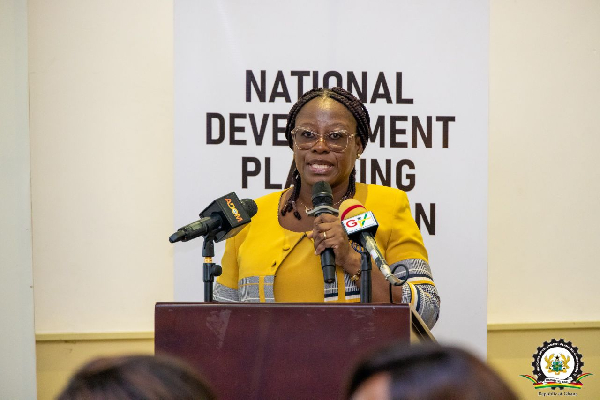
The Director-General of the National Development Planning Commission (NDPC), Dr Audrey Smock Amoah, has urged a more coordinated national response to tackle Ghana’s growing human capital challenges.
Addressing the Inter-Ministerial Coordinating Committee meeting on Ghana’s National Human Capital Development Strategy (HCDS) in Accra on Thursday, November 20, 2025, Dr Amoah stressed that Ghana’s long-term socio-economic transformation depends heavily on developing, empowering, and retaining a skilled and productive workforce.
“Ghana’s quest for socio-economic transformation cannot be divorced from its commitment to human capital development,” she said. “With the rapid rise of artificial intelligence and technological change, the country must strategically invest in its people to build the competencies needed to drive innovation and sustainable development.”
She cited major challenges—including demographic pressures, persistent labour-market mismatches, ongoing migration of skilled professionals, and fragmentation in sectoral efforts—and called for stronger leadership and coordination among ministries and agencies.
“The urgency of this strategy cannot be overstated,” she stressed. “These challenges make coordinated ministerial support not just desirable but absolutely necessary.”
Dr Amoah reaffirmed the NDPC’s call for closer collaboration among government, industry, academia, and research institutions to advance the HCDS.
Co-Principal Investigator and Country Research Manager at Thrive, Dr Kwabena Tandoh, described the HCDS as a transformative roadmap for national development from 2026 to 2057. He highlighted focus areas such as early childhood development, education reforms, stronger parental involvement, improved teacher motivation, and integrated health and social programmes.
Although Ghana is increasingly recognised as a leader in early childhood development, Dr Tandoh noted that significant barriers remain. He said the strategy aims to drive both economic growth and social equity through locally driven solutions.
Principal Planning Analyst at NDPC, Peter Porekuu, elaborated on the core components of the HCDS, stressing the need to build a modern workforce equipped with critical thinking, STEM capabilities, and skills aligned with the Fourth Industrial Revolution. He pointed to national challenges including weakening family structures, rural–urban disparities, skills gaps, infrastructure deficits in emerging regions, gender inequalities, cultural constraints, and the persistent brain drain.
The HCDS prioritises improving learning outcomes, health, skills development, and productivity. It aligns with the President’s Resetting Ghana Agenda, which focuses on rebuilding the economy, strengthening institutions, restoring productivity, and placing citizens at the centre of national development.
Thursday’s meeting marked a significant step toward enhancing coordination across key sectors—education, health, jobs, and social protection—to advance a unified approach to accelerating Ghana’s human capital development.
Comments