
NPP tears into Mahama gov’t over Accra floods, demands accountability
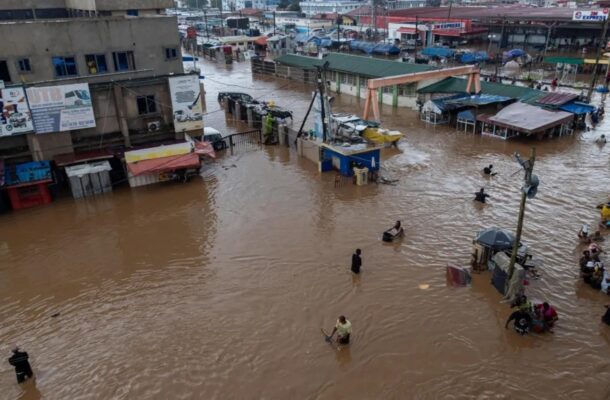
The New Patriotic Party (NPP) has launched a strong attack on the Mahama administration over the recent flooding that devastated several parts of Accra, accusing the government of poor coordination, weak leadership and failing to implement effective flood control measures despite repeated warnings.
The opposition party argues that the latest disaster, which has claimed lives, displaced hundreds of residents and caused widespread destruction to homes, businesses and public infrastructure, exposes serious weaknesses in the government’s management of Ghana’s perennial flooding problem.
In a statement signed by the NPP General Secretary, Justin Kodua Frimpong, on June 29, 2026, the party expressed sympathy to families who lost loved ones and residents whose properties were destroyed by the torrential rains that submerged several communities across the Greater Accra Region.
Among the areas affected were the N1 Highway, Apenkwa, Achimota, Kaneshie, Weija, Spintex, Darkuman Junction, Teshie and the Kwame Nkrumah Interchange, where floodwaters overwhelmed drainage systems, stranded motorists and disrupted economic activities.
According to the NPP, the recurring floods reflect what it described as ineffective governance and the failure of the current administration to put in place sustainable flood prevention measures.
The party maintained that while flooding has remained a recurring challenge in Accra for decades, the response of the current government has lacked coordination and strategic direction.
Central to the NPP’s criticism is the structure established by government to manage flood prevention and emergency response.
The party questioned why responsibilities for flood management have been split between the Ministry of Local Government and the Ministry of Works, Housing and Water Resources, arguing that the arrangement has created overlapping responsibilities and uncertainty over which institution is ultimately accountable.
According to the opposition, the fragmented approach has weakened decision-making and slowed the implementation of flood mitigation measures.
The statement also questioned the reported involvement of a Deputy Chief of Staff in coordinating aspects of government’s flood response, arguing that such an arrangement blurs institutional responsibilities and undermines established administrative structures.
The NPP further alleged that several flood mitigation initiatives announced by government have either failed to materialise or have been poorly executed, while funding constraints have reportedly delayed the implementation of key interventions designed to reduce flooding in vulnerable communities.
The party also criticised remarks attributed to President John Dramani Mahama during a town hall meeting outside Ghana, where he reportedly cited human behaviour, including indiscriminate dumping of refuse and encroachment on waterways, as major contributors to the flooding.
According to the NPP, while environmental practices contribute to flooding, government should not shift responsibility onto citizens but rather accept full accountability for planning, implementing and maintaining effective flood control infrastructure.
The party insisted that it is the responsibility of government to ensure proper drainage systems, enforce planning regulations and coordinate emergency response mechanisms capable of protecting lives and property during periods of heavy rainfall.
To address the situation, the NPP has called for a comprehensive review of Ghana’s current flood management framework.
Among its recommendations is the consolidation of all flood management responsibilities under a single ministry to eliminate duplication and improve coordination.
The opposition is also demanding the appointment of a clearly designated lead authority with full responsibility for flood prevention, emergency response and long-term mitigation planning.
Additionally, the NPP has called on government to publicly account for the activities, decisions and expenditure of the anti-flood task force established to coordinate interventions.
The party further urged closer collaboration between central government, Metropolitan, Municipal and District Assemblies, engineers, urban planners and environmental experts to tackle persistent challenges including poor drainage, uncontrolled development, encroachment on waterways and inadequate sanitation systems.
The latest criticism comes after President Mahama announced a series of emergency and long-term interventions following an aerial inspection of flood-hit communities.
The President directed the Minister for Finance to release funds from the Contingency Fund to support victims through the National Disaster Management Organisation (NADMO), while also announcing plans to demolish structures obstructing waterways and develop a new city outside Accra as part of efforts to reduce population pressure on the capital.
Government has also attributed the disaster to a combination of unusually heavy rainfall, climate change, illegal construction on waterways and indiscriminate waste disposal.
However, the NPP maintains that these explanations do not absolve the administration of its constitutional responsibility to protect lives and property through effective planning and infrastructure development.
The party concluded by assuring flood victims of its solidarity and pledged to continue holding government accountable until lasting solutions are implemented to end Accra’s recurring flood disasters.





Popular News
No trending posts found.