
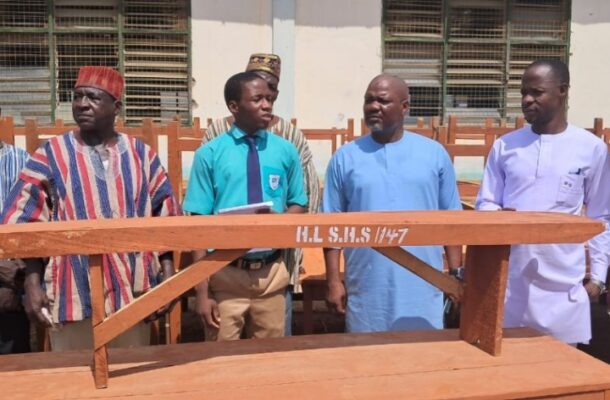
The Human Security Department of the National Security Council (NSC) has donated a full set of dining hall tables and benches to Hilla Limann Senior High School in the Sissala West District of the Upper West Region, as part of efforts to enhance student safety and reduce off-campus movement that could expose students to radical influences.
The donation was presented during a brief ceremony attended by school officials, local authorities, and community leaders.
Mr. Hakeem Duweija, Director of Projects at the NSC, said the initiative forms part of a broader national strategy to address security risks facing young people through improved school infrastructure.
“We have identified that inadequate school infrastructure, especially in dining and boarding facilities, creates a gap that extremist groups can exploit," Mr. Duweija stated. "When students are forced to leave school grounds just to find a place to eat, they become vulnerable to outside influences. This donation is meant to help keep them safe, supervised, and focused on their education."
Headmaster Mohammed Bakor Zakaria expressed appreciation for the gesture, noting that the new furniture would enable over 1,000 students to dine safely and comfortably on campus.
“This is more than just furniture,” he said. “It’s an investment in the safety and stability of our students. We now have the means to discourage unnecessary movement and protect our students from potential dangers beyond the school gates.”
The District Chief Executive (DCE), Abudu Fusieni Gbene, commended the NSC for linking security to infrastructure development, describing the intervention as a practical approach to prevention.
“This is what real security looks like prevention through smart, practical support. Our students deserve to learn in environments that are not just academically sound, but also secure,” Gbene remarked.
Chief of the Traditional Area, Kouro Daniel Limman, also lauded the initiative and called on the community to support efforts to safeguard the youth.
“Our young people are our future. It is our duty together with the state to shield them from harmful paths. What we have witnessed today is a clear example of leadership that cares,” the Chief said.
Mr. Duweija added that similar interventions would soon be extended to other vulnerable school communities nationwide as part of the NSC’s human security framework, which addresses non-traditional threats such as infrastructure deficits, poverty, neglect, and social exclusion.
“Security is not just about weapons and walls,” he said. “It’s about creating environments that protect, empower, and guide our youth away from danger. That’s our mission.”
Comments